
You bought the blackout curtains. You hung them up. And at ten in the morning there is still a stripe of light lying across your pillow, a bright line above the rod, and a glow creeping under the hem.
Most blackout bedroom ideas stop at the curtain. That is the part everyone gets right and it is rarely the part that fails. Light gets in above the rod, around the sides, under the fabric, off a mirror, off a white ceiling, off pale carpet you never thought about.
Sleeping while the rest of the world is awake is harder than anyone tells you before your first run of nights. It takes more than one purchase, and some of what works costs nothing at all.
The 25 ideas below come from real bedrooms. Some take a weekend and a paintbrush. Some take twenty minutes and a screwdriver. A few just involve moving your bed.
They are grouped so you can start at the window, close the gaps you have not noticed, then work outward into the room itself.
1. Mount the Rod at Ceiling Height, Not Above the Frame
The single most common blackout mistake is hanging the curtain too low.
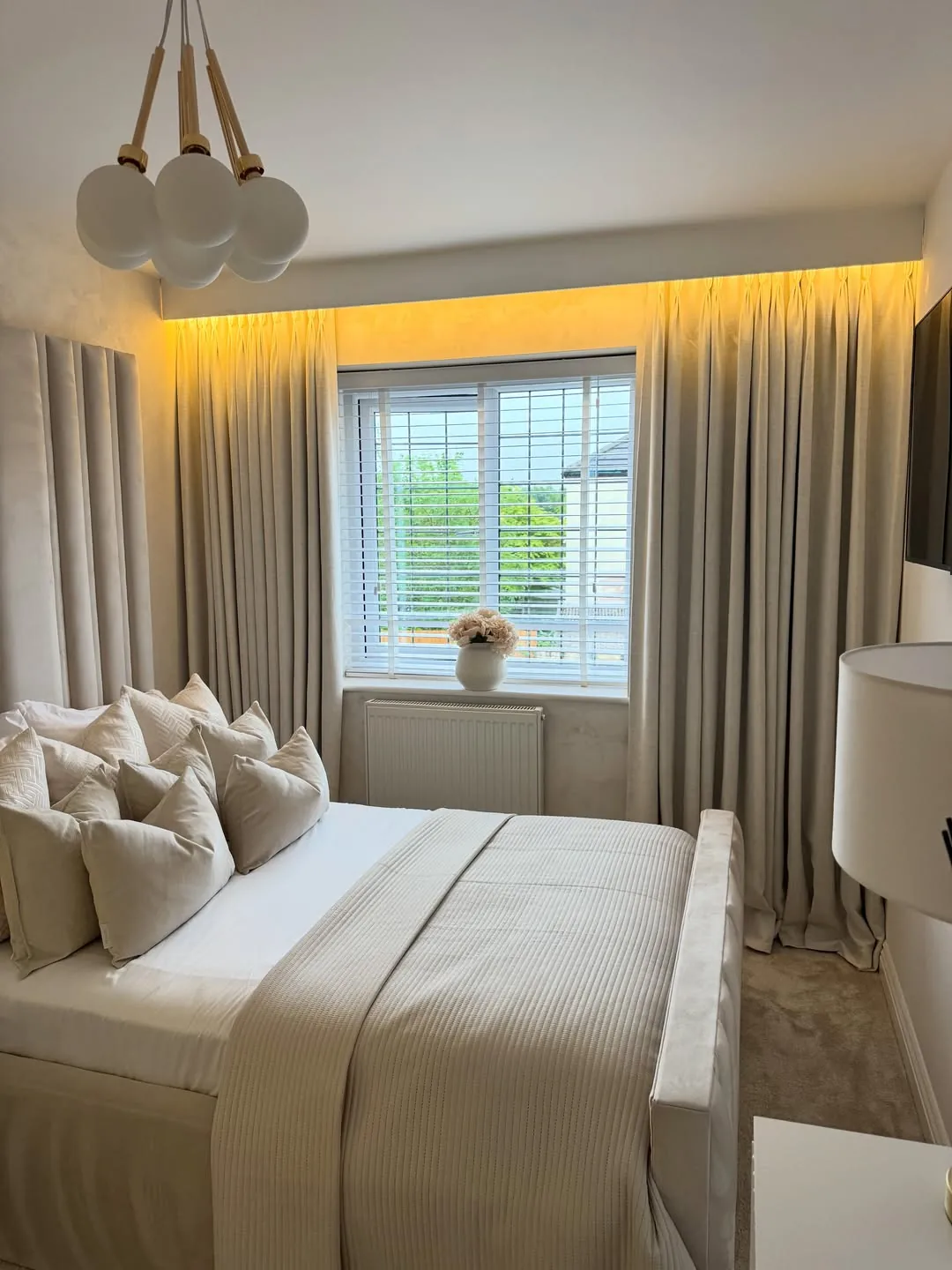
Here the cream pinch-pleat curtains start at the ceiling line and drop all the way to the carpet. Because the rod sits high, there is no gap between the top of the curtain and the ceiling for light to spill through.
There is a second detail worth copying. A warm strip light runs along the top behind the curtain heading, washing the fabric in amber, and the window itself has white venetians behind. This room is already running two layers.
Rod fixed just above the window frame. A bright band of light across the ceiling every morning, right in your eyeline when you lie down.
Rod at the ceiling, curtain to the floor. No top gap, and the window looks considerably taller as a bonus.
2. Close the Gap Above Grommet Curtains
Look at the top of the curtain in this photo and you will see the problem instantly.
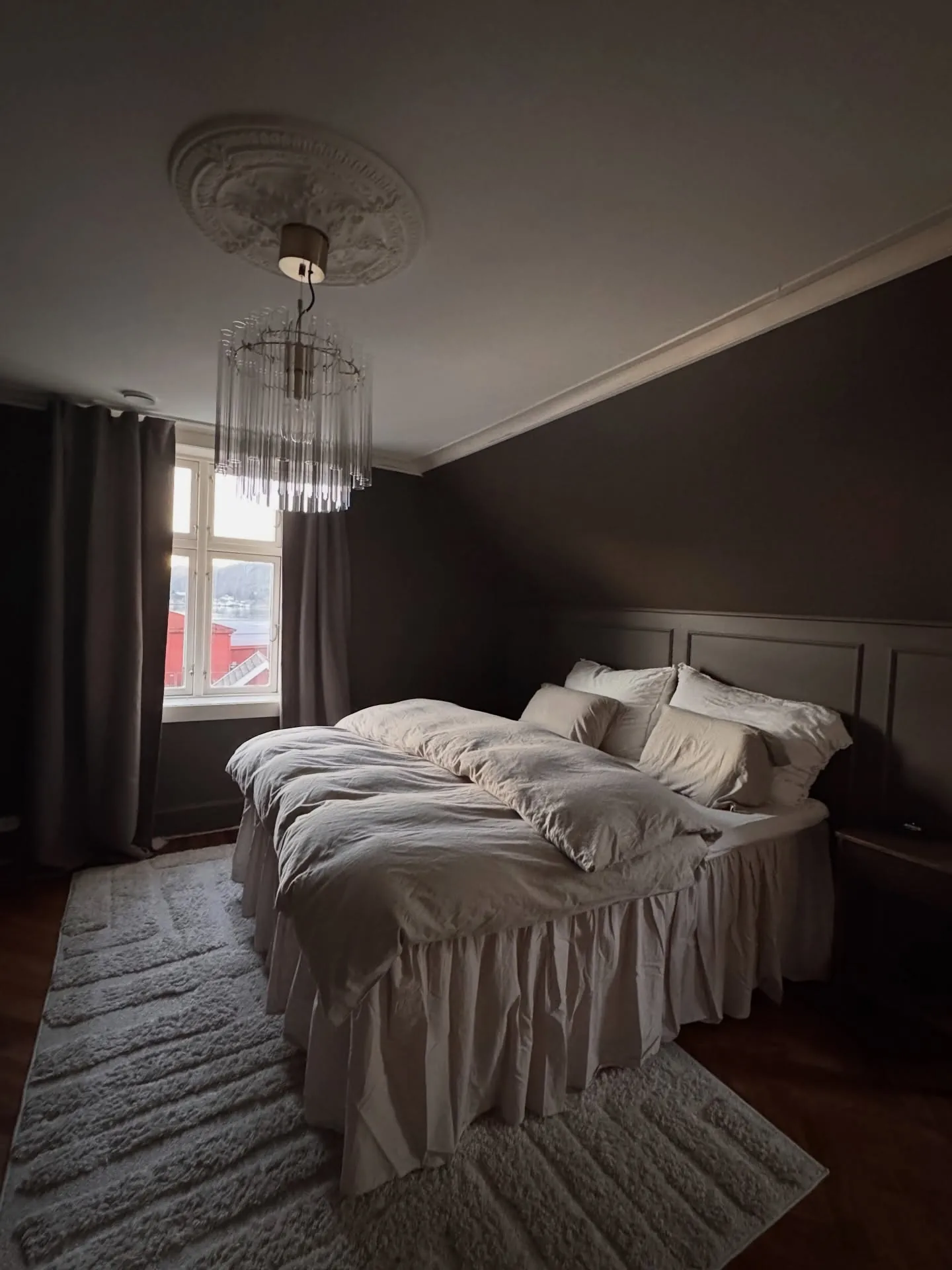
Grommet curtains hang from rings that sit below the rod, which leaves a permanent open channel along the top. In this taupe room the light coming through that gap is clearly visible, even though the curtain fabric itself is heavy.
Three ways to fix it, cheapest first:
- Wrap the rod. Loop the first and last grommet behind the rod so the fabric hugs it at both ends.
- Add a valance. A short fabric pelmet across the top hides the channel entirely.
- Build a pelmet box. A shallow three-sided box above the window blocks the top and the sides at once.
Warm taupe walls, matching panelling and a dark floor are absorbing far more light here than white ones would.
Stand where your head lands on the pillow and look at the window at midday.
Note every bright line you can see. Top, sides, bottom, and around the rod.
Fix the top gap first. It sits directly in your eyeline when you lie down.
3. Bay Windows Need a Curved Track, Not Three Separate Rods
Bays are the hardest shape to darken, and this room shows the right approach.
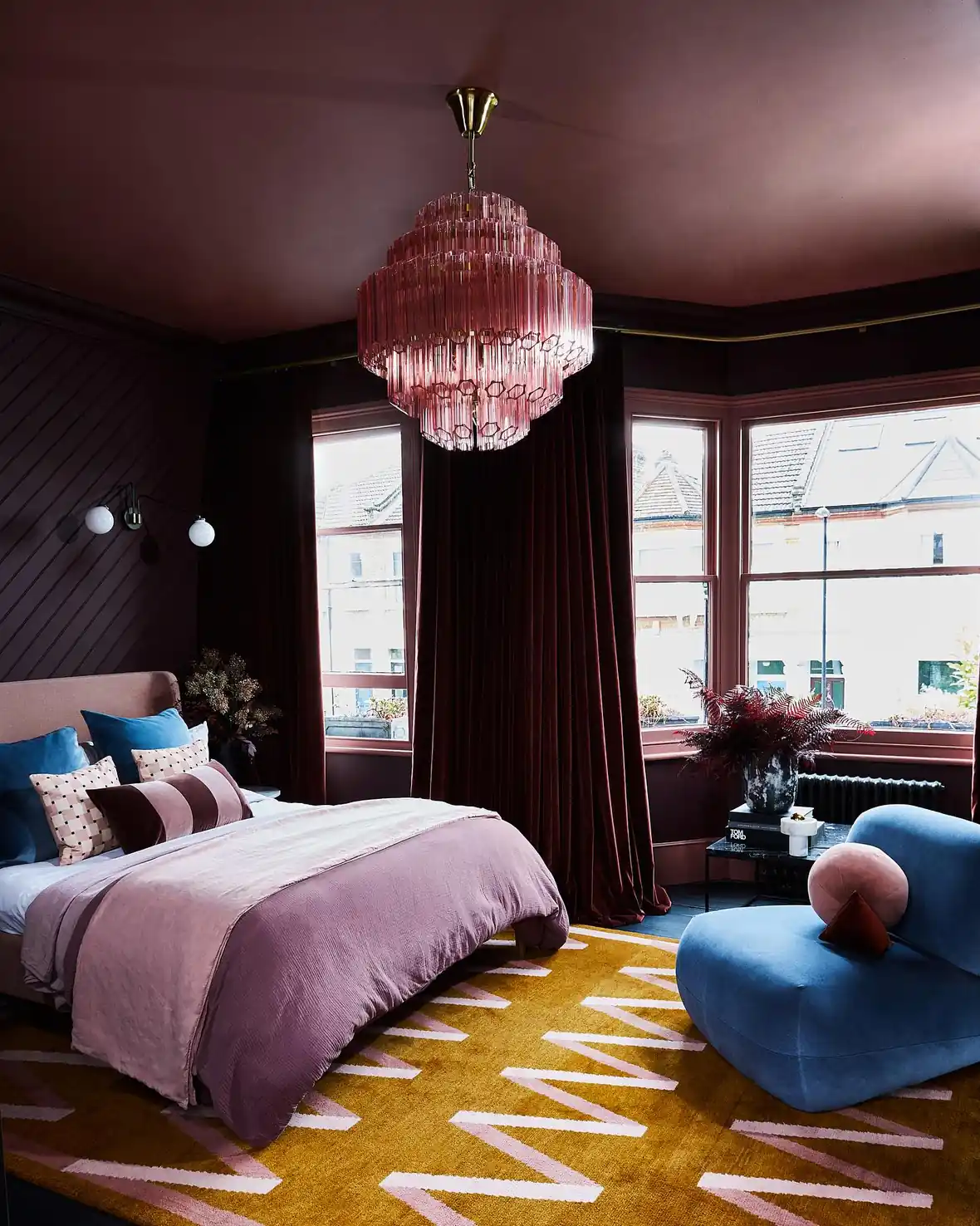
A brass track follows the full curve of the bay, so one continuous run of deep red velvet draws across all three sections at once. No gaps at the angles, which is exactly where three separate rods leak.
The room commits elsewhere too. Walls, ceiling and panelling are all a deep plum, and the window frames are painted the same dusty pink as the ceiling rather than left white.
| What to get right | Why it matters |
|---|---|
| A single bent track | No bright line at each corner |
| Extra fabric width | Each section stays covered when drawn |
| Floor length, not seat length | Nothing spills underneath |
| Frames painted to match | No white outline around the glass |
| Three straight rods | One curved track |
|---|---|
| Cheap and available anywhere | Made to measure, costs more |
| A vertical light line at every angle | Continuous fabric, no corner gaps |
| Three sets of curtains to wrestle | One pull closes the whole bay |
4. Recess the Curtain Track Into the Ceiling Line
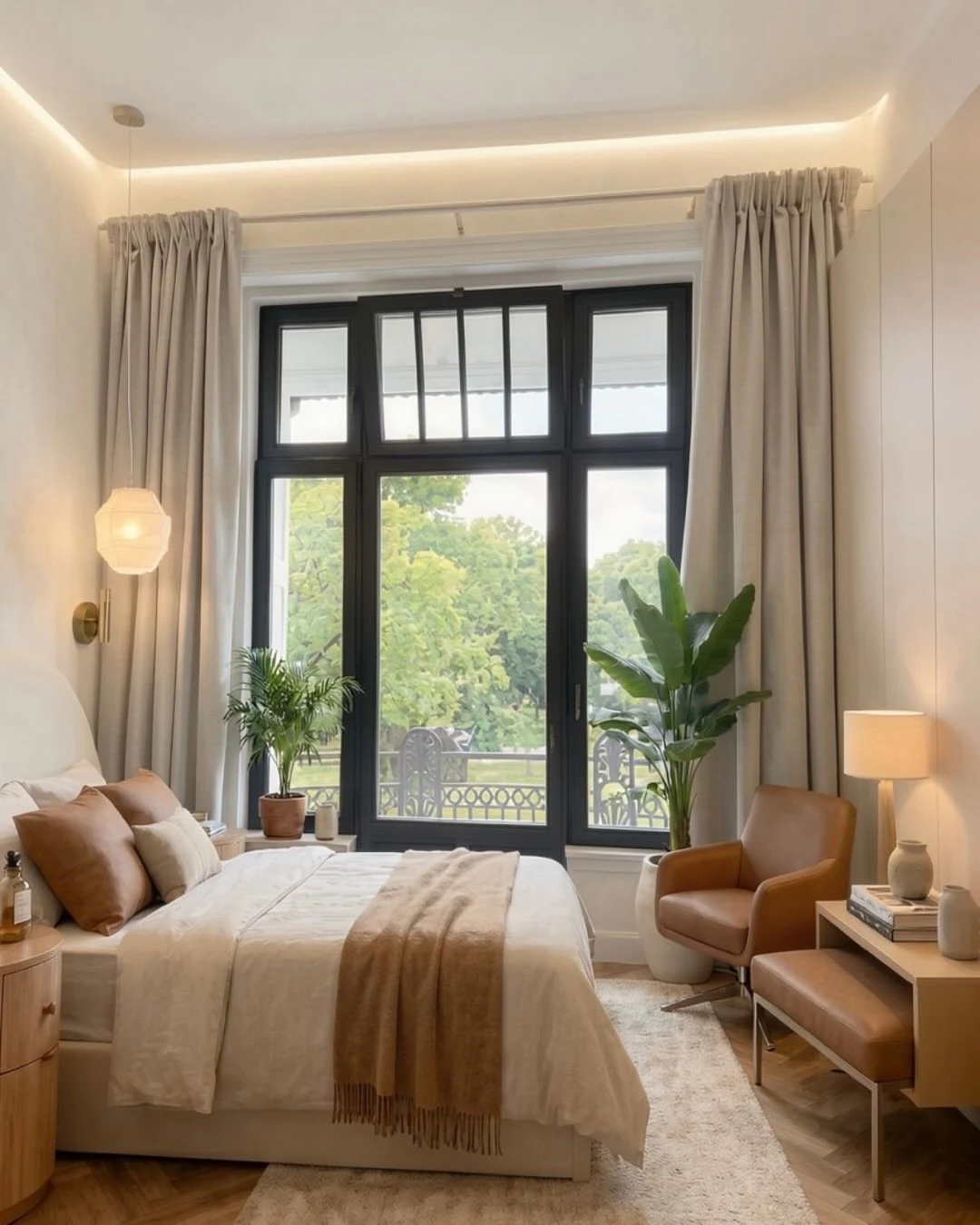
The neatest version of the ceiling-mounted curtain, and the one that removes the top gap completely.
The track here sits inside a shallow recess where the wall meets the ceiling, with a soft light strip running alongside it. The curtains appear to emerge from the ceiling itself. No rod, no rings, no visible channel above the fabric.
What makes this version work
A plasterer can build this recess in a day. A surface-mounted ceiling track gets you most of the effect for a fraction of the cost.
5. Short Curtains Leave the Worst Gap of All
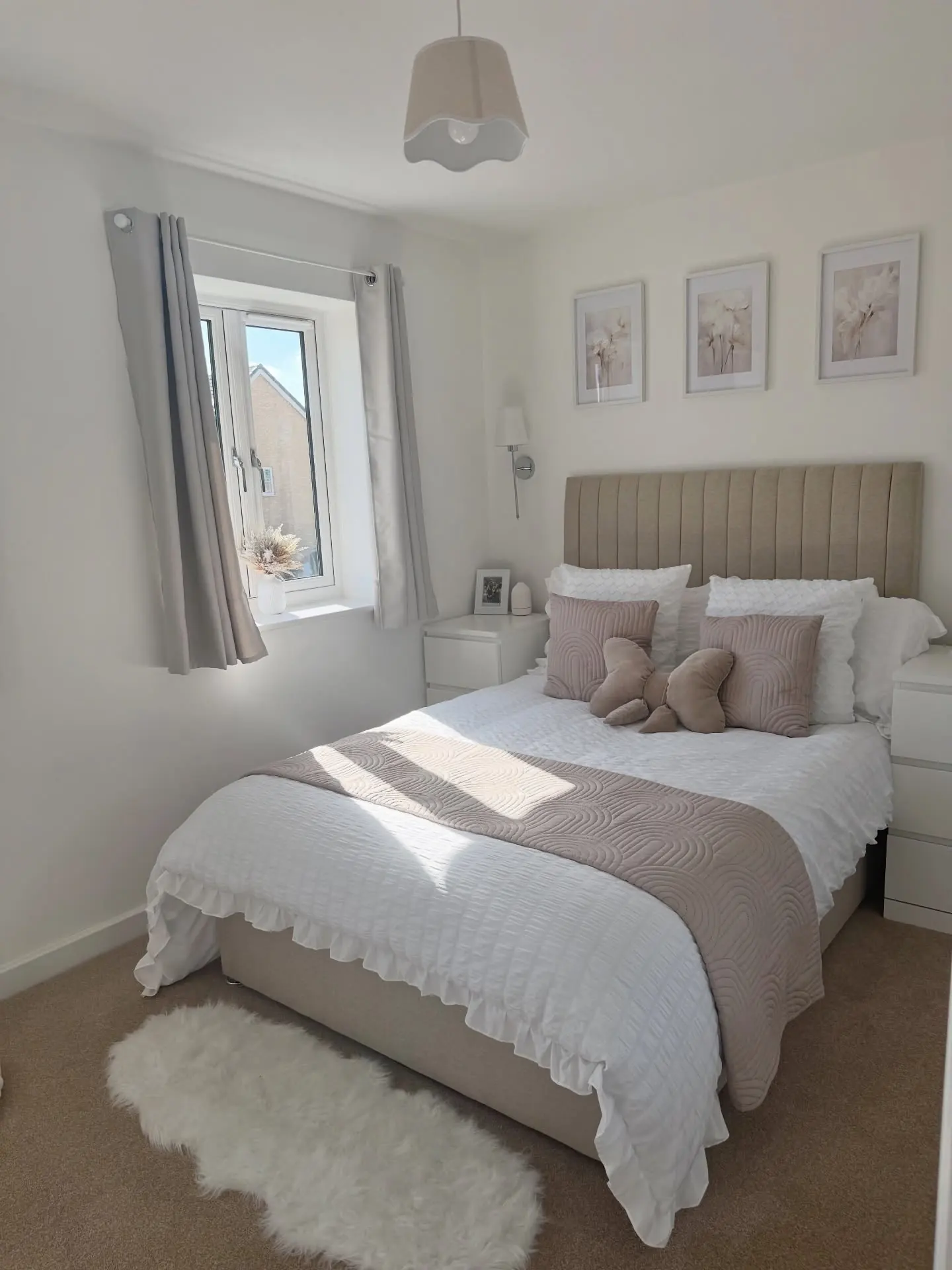
There is a stripe of sunlight lying directly across the bed in this photo, and it tells you everything.
The curtains stop at the windowsill. Below them the wall, the radiator and the pale carpet are all fully lit, and that light travels straight across the room to the pillows. The rest of the space is white walls, cream bedding and white furniture, so nothing absorbs it.
Sill-length curtains cause three problems at once:
- Light spills under the hem and across the floor
- Pale carpet reflects that light back upward
- The window looks smaller, so the room feels smaller
⚠️ Watch Out
If a radiator sits under the window, floor-length curtains will block the heat. Fit a blackout roller blind inside the recess instead, and keep the curtains at sill length for looks only.
6. Line Your Existing Curtains Instead of Replacing Them
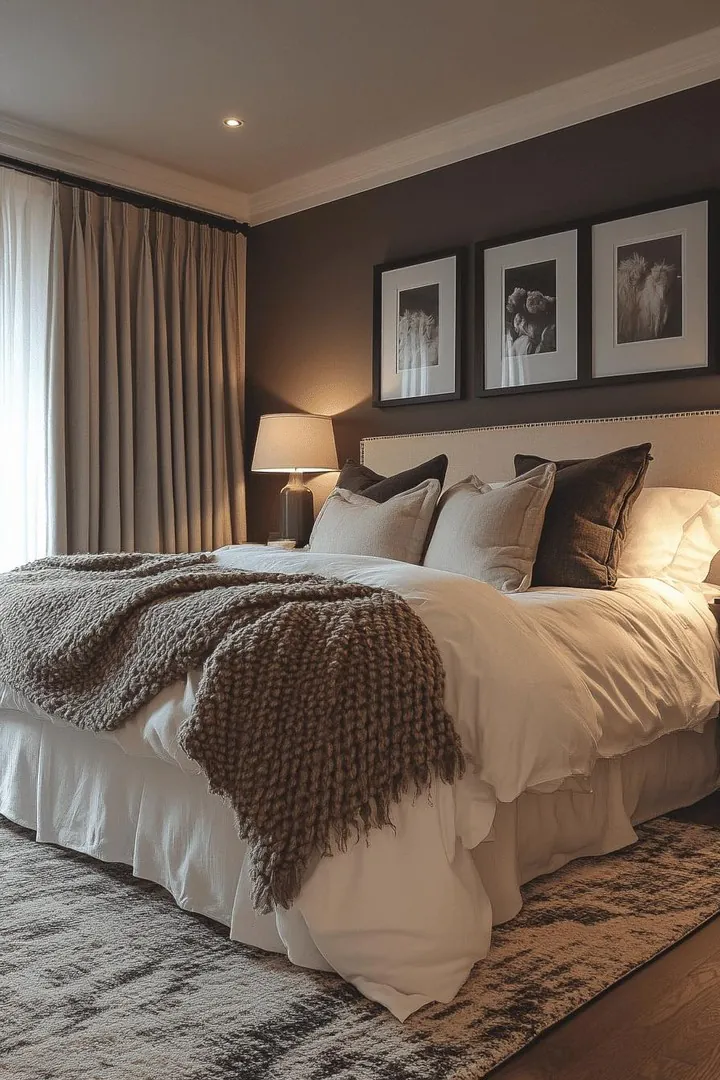
Not every fix means buying blackout panels in a colour you dislike.
The curtains here are soft oatmeal linen, pinch pleated, hung on a slim rod that extends past the window on both sides. They look light. They are not necessarily letting light through, because a blackout liner can sit behind a decorative face fabric.
You keep the colour and drape you actually want, and the darkness happens out of sight.
The chocolate feature wall behind the bed does quiet extra work. Dark paint opposite the window means less bounce back into the room.
7. Two Layers on One Track, Sheer in Front and Solid Behind
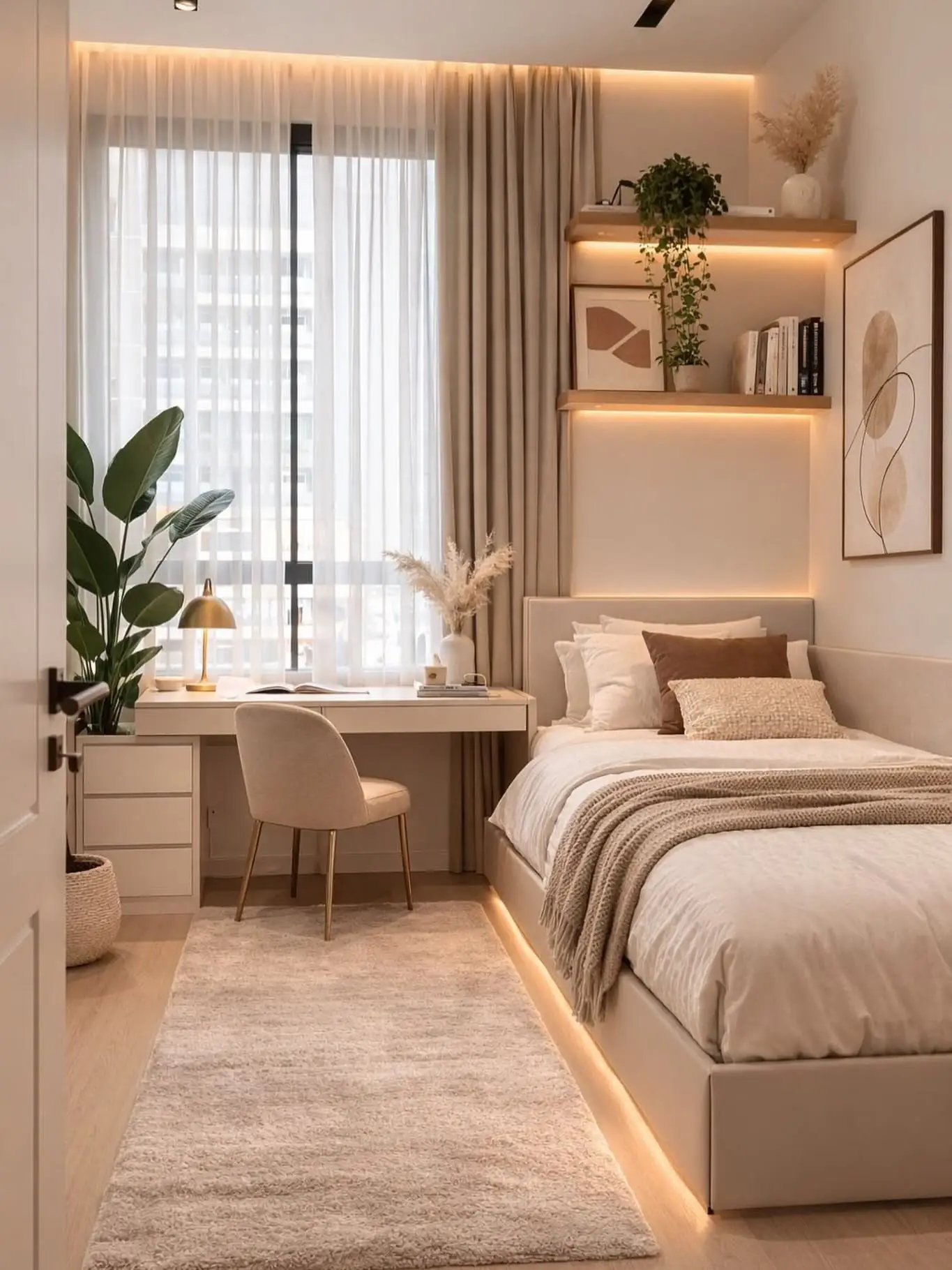
Small rooms rarely have space for two separate curtain rails. This one solves it on a single header.
A white sheer runs across the window, and a heavier taupe curtain sits alongside it on the same track, ready to be pulled across. During the day you use the sheer. Before sleep you drag the solid layer over.
Setting this up takes three decisions:
- Order matters. The solid layer goes on the room side, so it can seal against the wall.
- Buy extra width. The solid panel needs to cover the whole window alone, not half of it.
- Choose a track, not a rod. Rods bunch fabric at the ends. A track lets both layers slide freely.
Mount a double track at ceiling height, wider than the window on both sides.
Hang the sheer on the window side and the blackout panel on the room side.
Add warm strip lighting under a shelf or the bed so you never need the ceiling light.
8. Run a Roman Shade Behind the Curtains
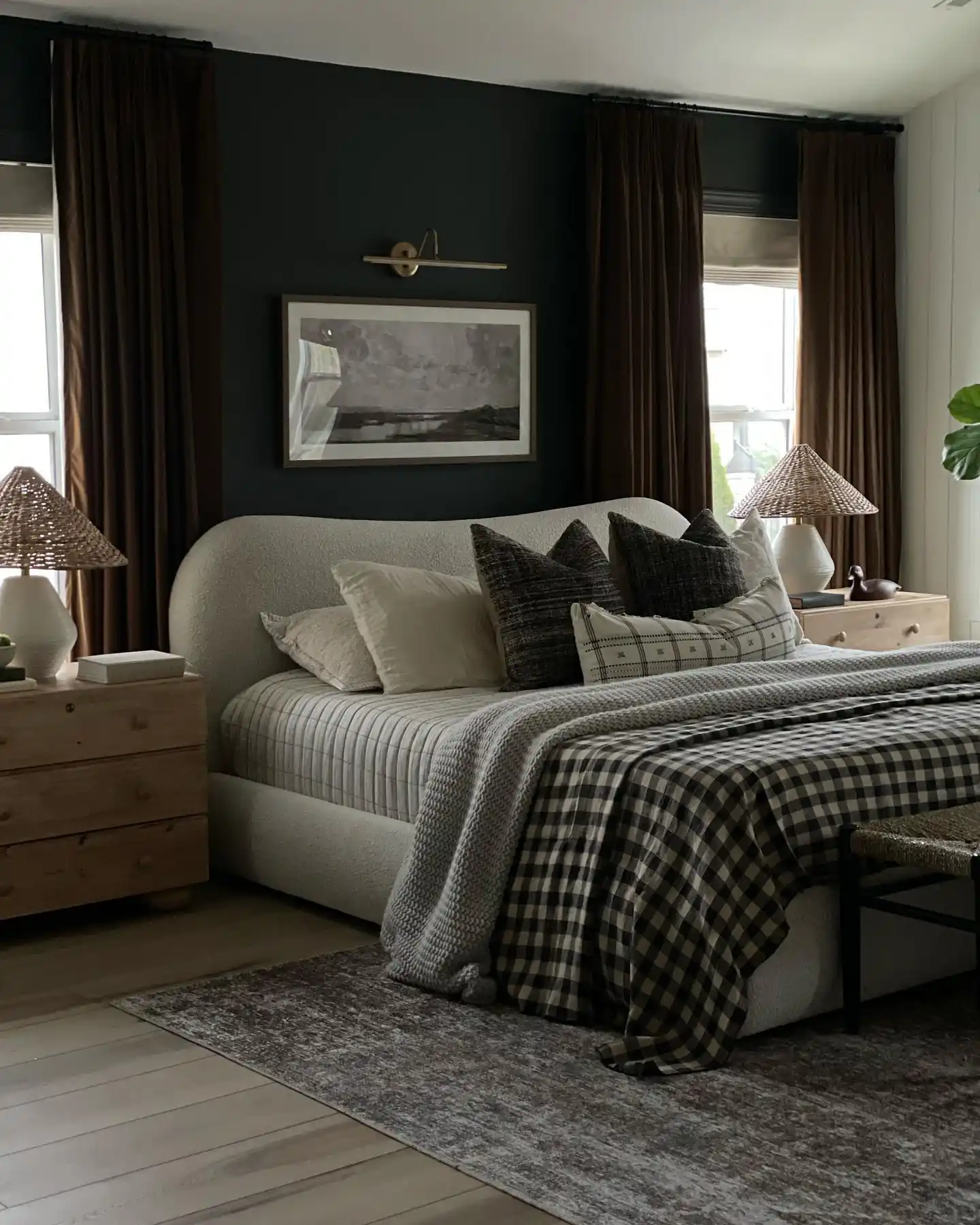
Two windows flank this bed, and each one runs two separate barriers.
Sitting inside each recess is a black roman shade, mounted tight to the frame. Hanging outside, on black rods, are floor-length curtains in warm rust velvet. Either layer alone would leak. Together they close most of the routes light takes.
The dark green wall between the two windows matters too. Anything that gets past both layers lands on matt dark paint rather than white plaster.
| Mount inside the recess | Mount outside the recess |
|---|---|
| Neat and flush, keeps the sill usable | Covers the frame completely |
| Always leaves side gaps | Makes the window look larger |
| Best as the inner layer | Best as the outer layer |
9. Wooden Venetians Give You Control That Curtains Cannot
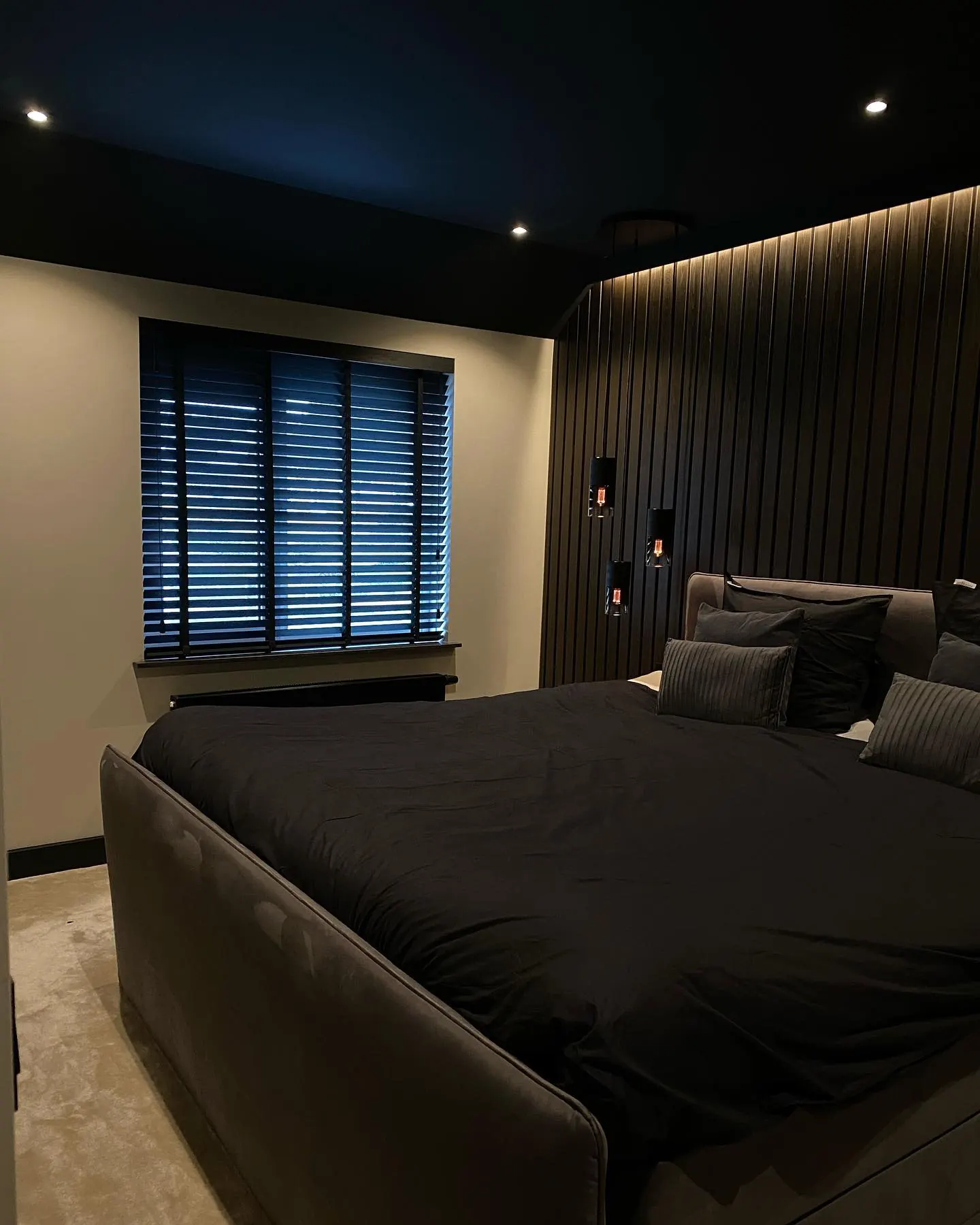
Curtains are all or nothing. Slats let you dial it.
This room pairs black wooden venetian blinds with tape ladders against a pale window recess. You can see thin bright lines between the slats, which is exactly the point of the photo. This is what a closed venetian actually looks like from the inside.
That level of light is fine for evening. For sleeping at eleven in the morning it needs a second layer.
The black painted ceiling is the smarter move here. Ceilings catch and spread daylight more than any wall does, and almost nobody thinks to paint them.
10. Know When a Sheer Layer Is Working Against You
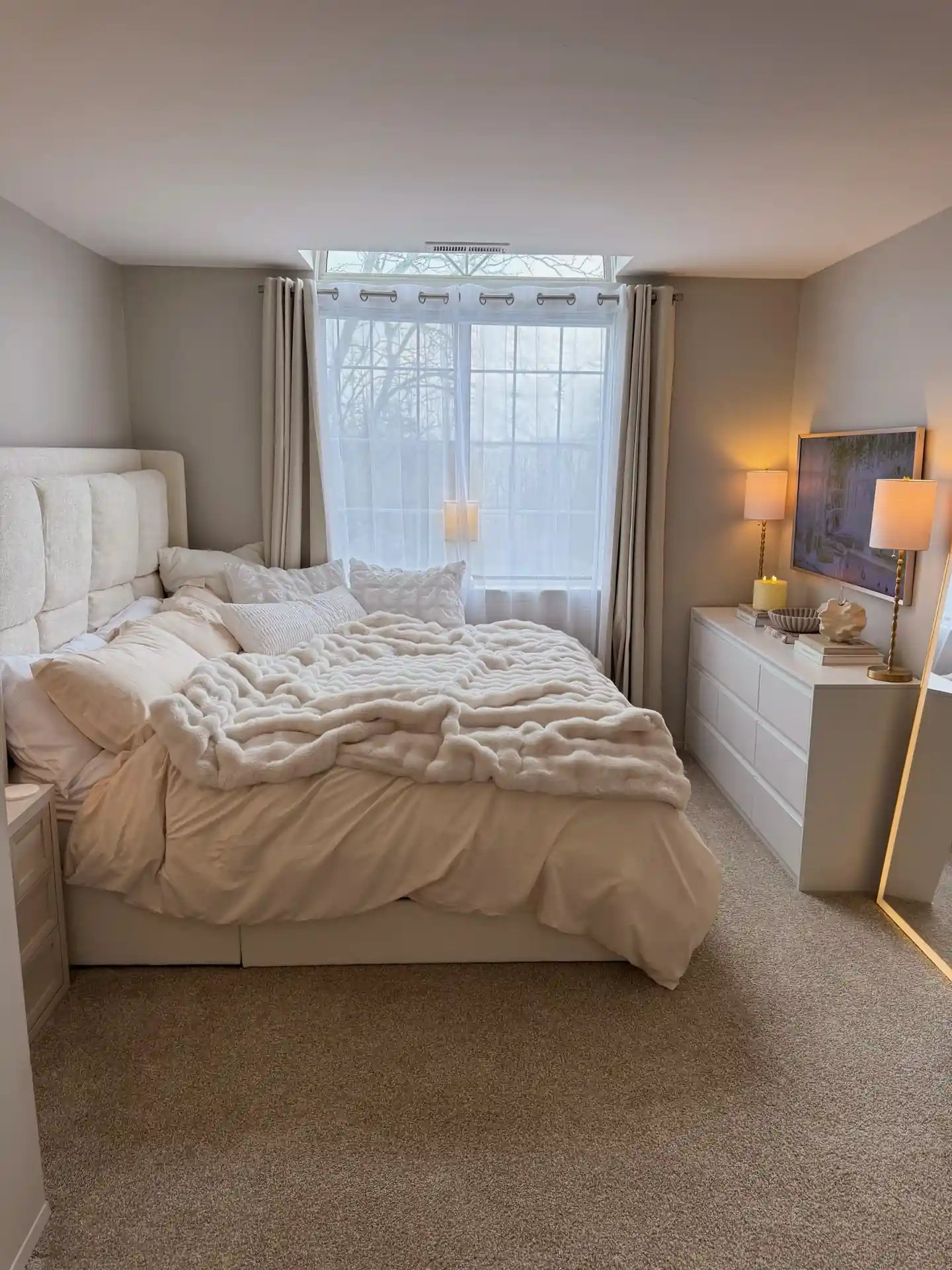
A beautiful room, and a useful warning.
Cream tones throughout, a soft faux fur throw, warm lamps on the dresser, a tall window centred behind the bed. The curtains are oatmeal, and there is a white sheer panel hanging in front of them.
The sheer is doing the opposite of what a day sleeper needs. Bright daylight pours straight through it, and the pale walls and carpet bounce that light around the whole room.
Lamps on the dresser instead of an overhead light.
Heavy textured bedding that feels like a nest.
The sheer panel. Lovely in the evening, useless at 10am.
A window directly behind the bed with nothing blocking it.
Sheers are not the enemy. They just need something solid behind them, and this room appears to have the lighter fabric in front.
11. One Dark Wall Does More Than Four Beige Ones
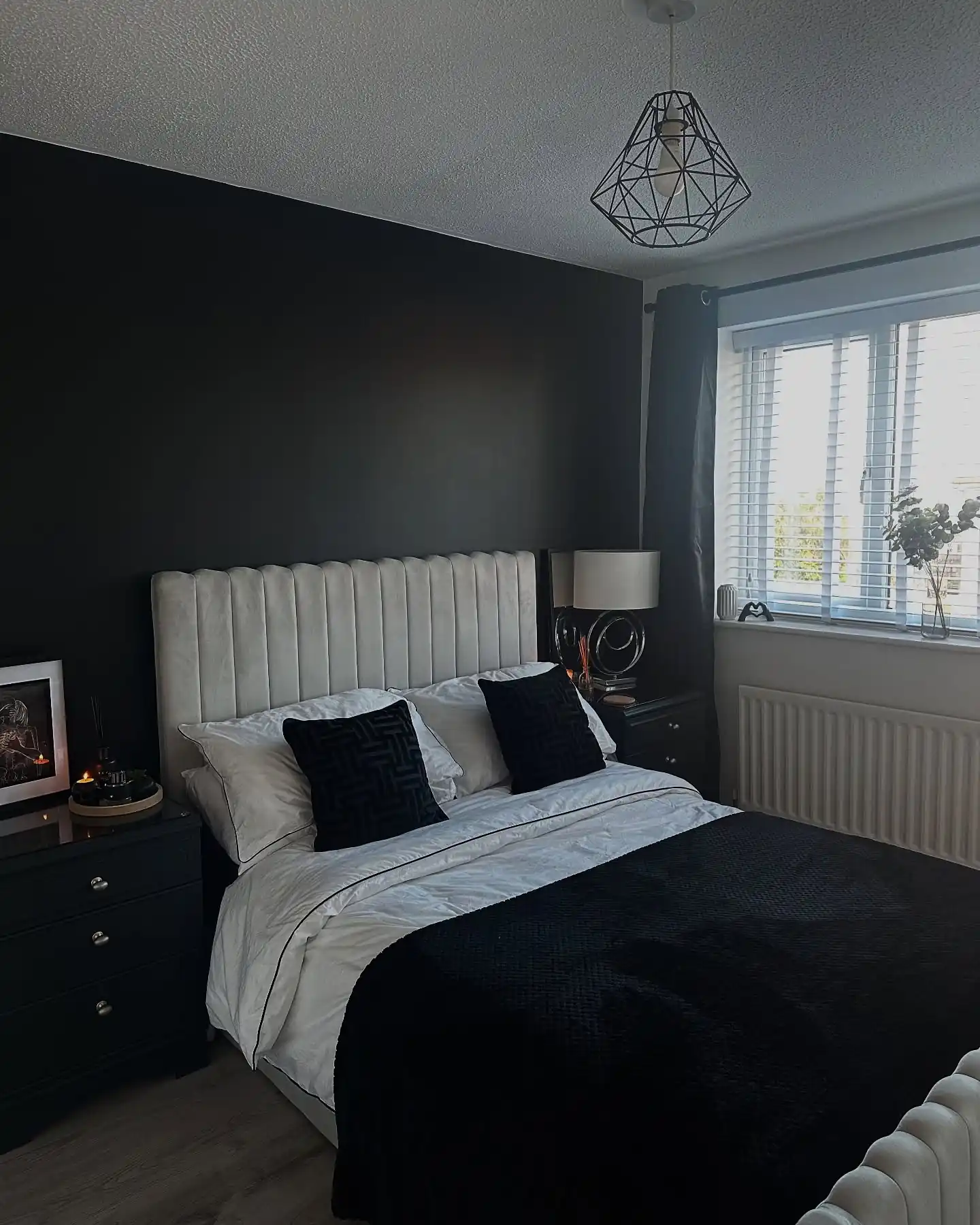
Painting a whole room black is a big commitment. Painting one wall is a Saturday.
The wall behind this bed is a deep near-black, and it changes the entire feel of the space. Everything else stayed as it was: white textured ceiling, pale flooring, white radiator, existing window with white venetians.
What sells it is contrast. A cream fluted velvet headboard against the dark paint, white bedding, black patterned cushions, black painted nightstands either side.
- ▸Choose the wall your bed sits against, not the window wall.
- ▸Keep one pale element against it so the room does not close in.
- ▸Matt paint absorbs light. Anything with sheen reflects it back.
- ▸A candle or diffuser on the nightstand adds warmth without adding light.
Renters can get close with removable wallpaper in a dark solid, or a wide fabric panel hung behind the bed.
12. Take the Paint Across Ceiling, Trim and Panelling
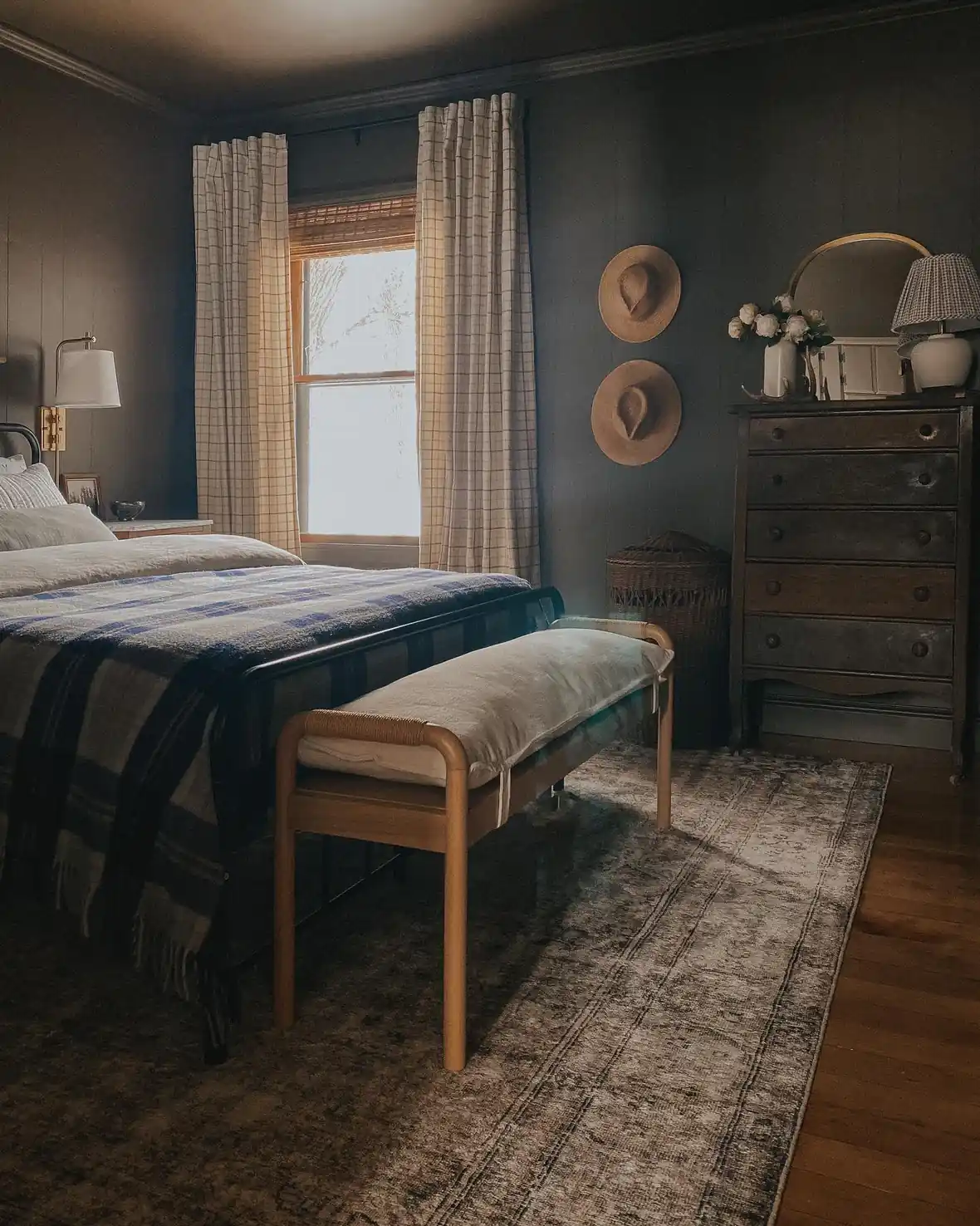
Stopping paint at the picture rail is what makes most dark rooms feel half finished.
Everything here wears the same muted blue-grey: walls, vertical panelling, window trim, cornice and ceiling. There is no white line anywhere to catch daylight and pull the eye upward.
The window keeps a light checked curtain with a woven bamboo shade behind. Two layers, but neither is heavy, because the room itself is doing most of the work.
Paint this, not just the walls
Matt on the walls, eggshell on the woodwork. Same colour, tougher finish where hands go.
13. Paint the Built-In Storage the Same Colour as the Walls
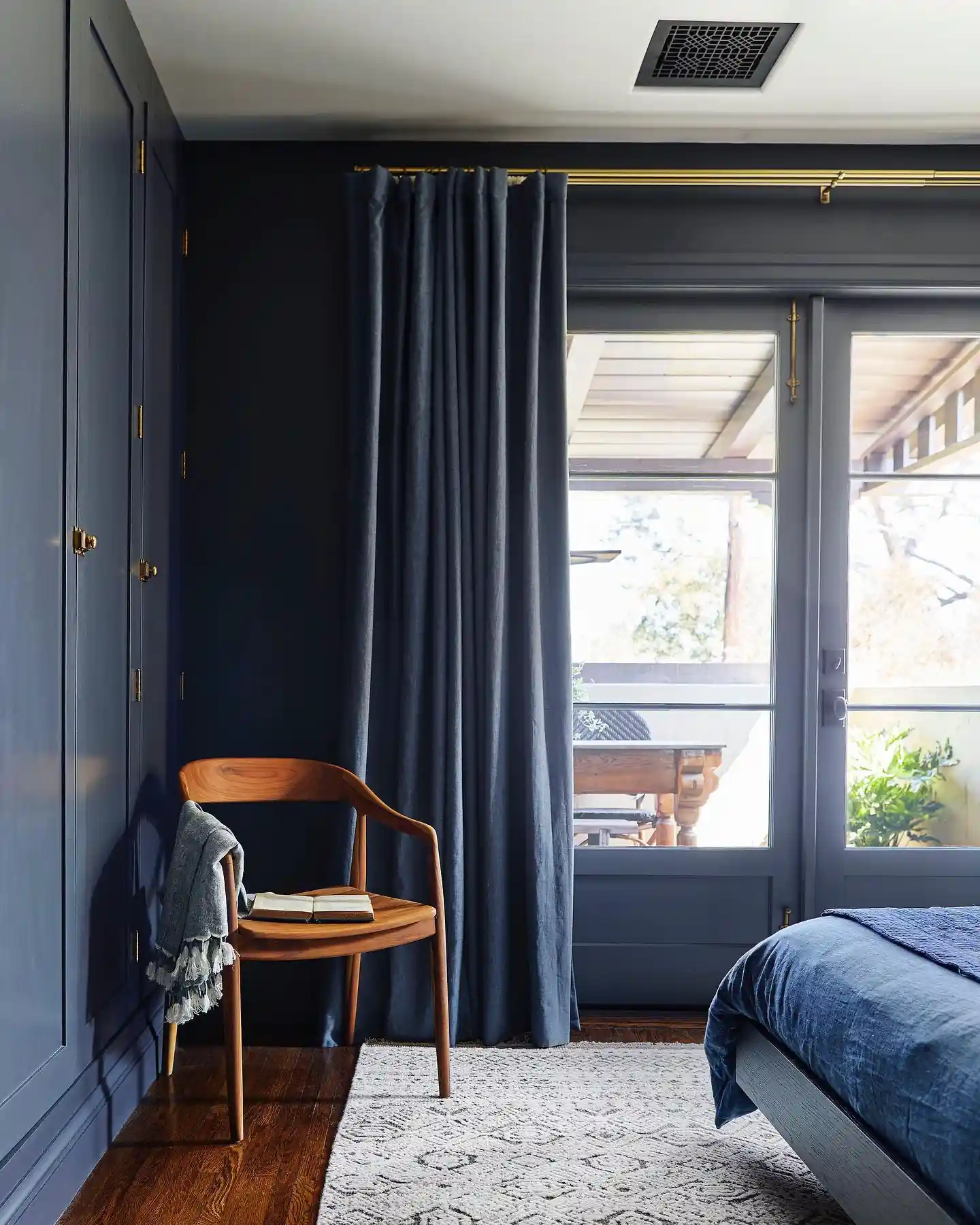
Wardrobe doors are usually the brightest thing in a bedroom. Painting them out changes that.
Here the fitted cupboards, the walls, and even the door and window frames all wear the same deep navy. Your eye reads one continuous dark surface instead of a wall with pale rectangles cut into it.
What that does for a day sleeper:
- Removes the biggest reflective panel in most bedrooms
- Makes the room calmer, since nothing catches the eye
- Lets a single dark curtain handle the glass door without looking odd
Renting means you cannot paint the wardrobes. A fabric panel hung across the closet front gets you partway there.
14. Slatted Wall Panels Swallow Light Instead of Bouncing It
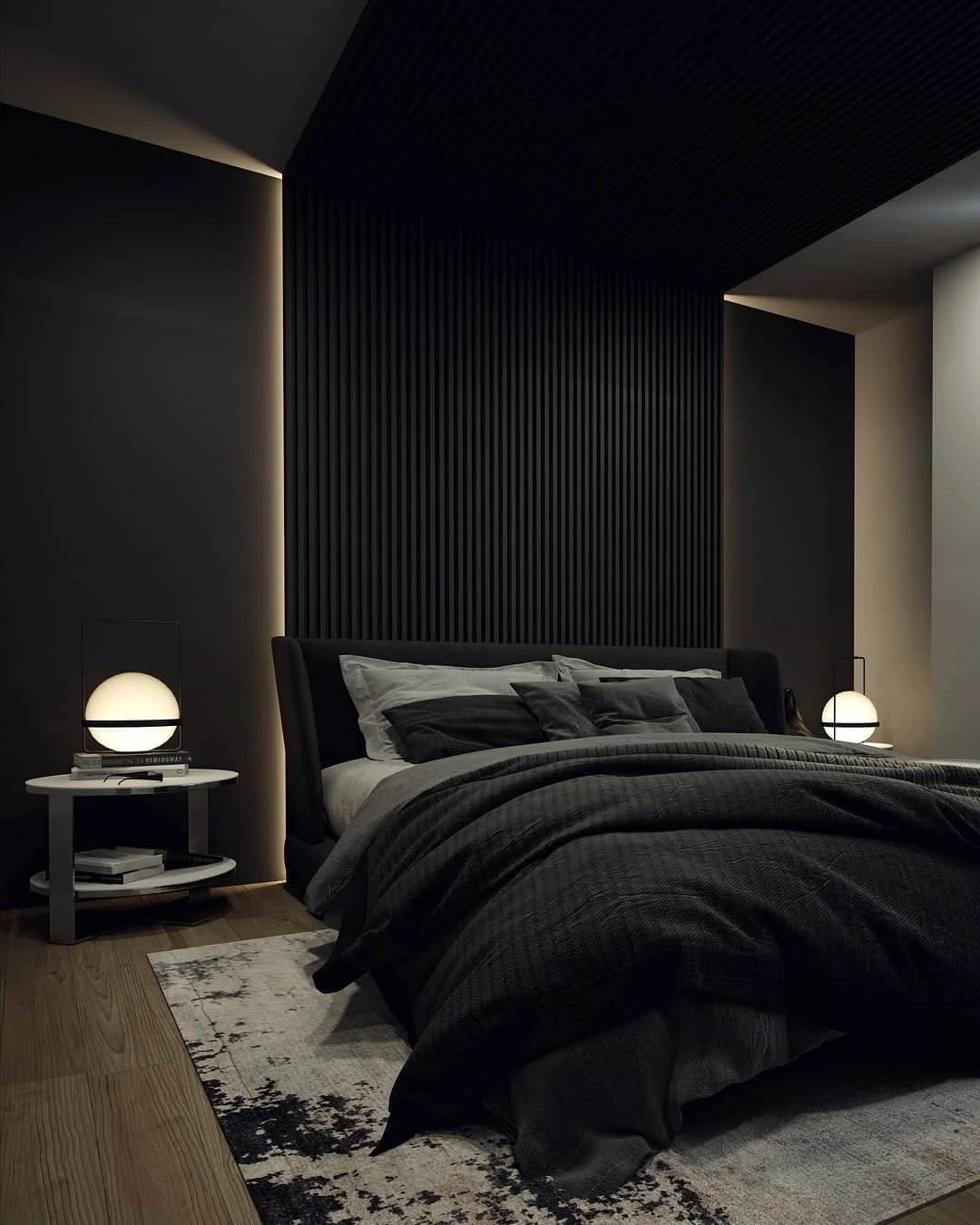
Flat paint reflects. Ridged surfaces do not, and this room shows why that matters when you sleep at noon.
The wall behind the bed is covered in narrow black vertical slats running floor to ceiling, and the same treatment carries onto the ceiling above the bed. Every groove creates a tiny shadow, so light that does get in gets absorbed rather than thrown back at your face.
Notice what is doing the work here:
- Slats on the wall and ceiling, so light has nowhere to bounce
- A warm strip hidden behind the panel edge, not overhead
- Two low globe lamps at bed height rather than a ceiling fixture
- Charcoal bedding, dark headboard, dark rug edges
The pale rug and cream side table stop it feeling like a cave. Without those two lighter pieces the room would read heavy rather than restful.
15. A Sloped Ceiling Painted Dark Stops Feeling Low
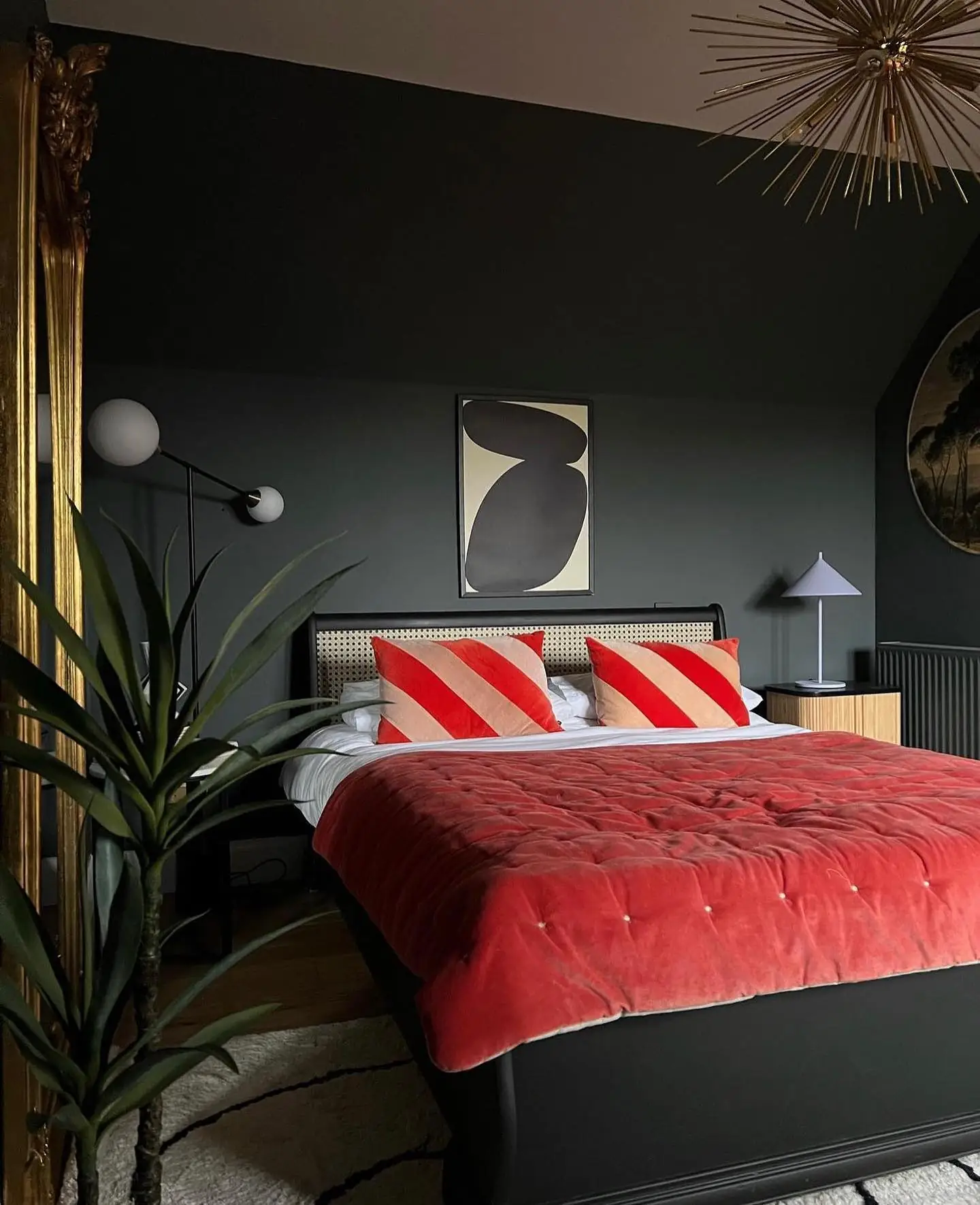
Common advice says paint a low ceiling white to lift it. In a bedroom for a day sleeper, ignore that.
The sloped ceiling and walls here are a deep charcoal green, and the room reads as enveloping rather than cramped. Against that, the bedding goes hard the other way: a coral velvet quilt, red and cream striped cushions, a cane headboard, a brass sputnik light.
Why the combination works:
- Dark above your head removes the brightest surface in an attic room
- The eye stops registering where the ceiling ends and the wall begins
- Warm colours in the bedding keep it from feeling severe
- Metallics catch lamplight at night without adding daytime glare
A white ceiling above a dark room is a screen that catches every bit of daylight that gets in. Painting it out removes the problem rather than managing it.
16. Layer Every Surface in Charcoal So Nothing Reflects
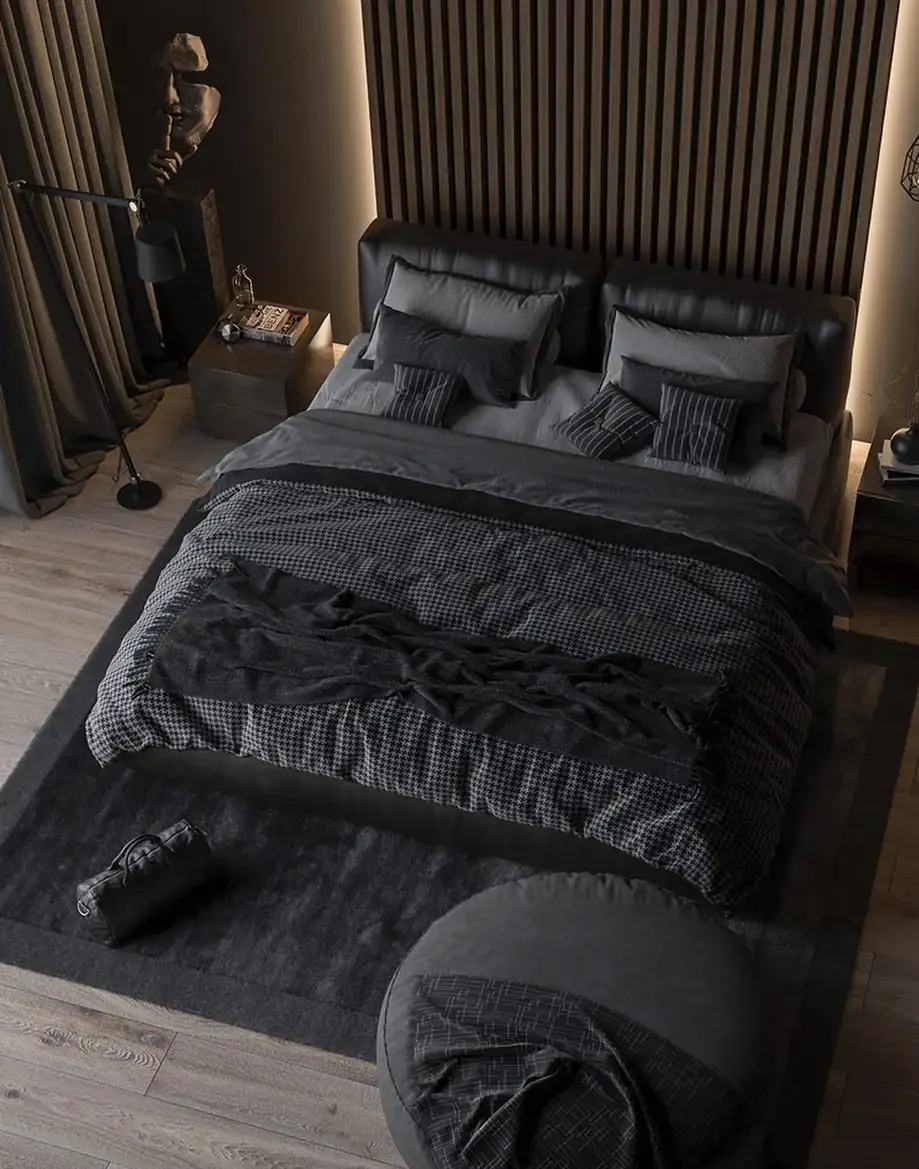
Committing halfway is what ruins most dark bedrooms. This one commits.
Count the surfaces in the overhead shot: charcoal duvet, grey sheet, dark rug over dark floor, black slatted headboard wall, near-black curtains at the far window. There is almost no pale surface for light to bounce off.
The curtains at the left are worth noting on their own. Floor to ceiling in a heavy fabric, wide enough to overlap the window frame generously on both sides.
Recreate this look
The exposed filament pendants are the saving grace. Amber light against all that charcoal keeps the room from feeling cold.
17. Dark Walls Do Not Mean Giving Up Colour
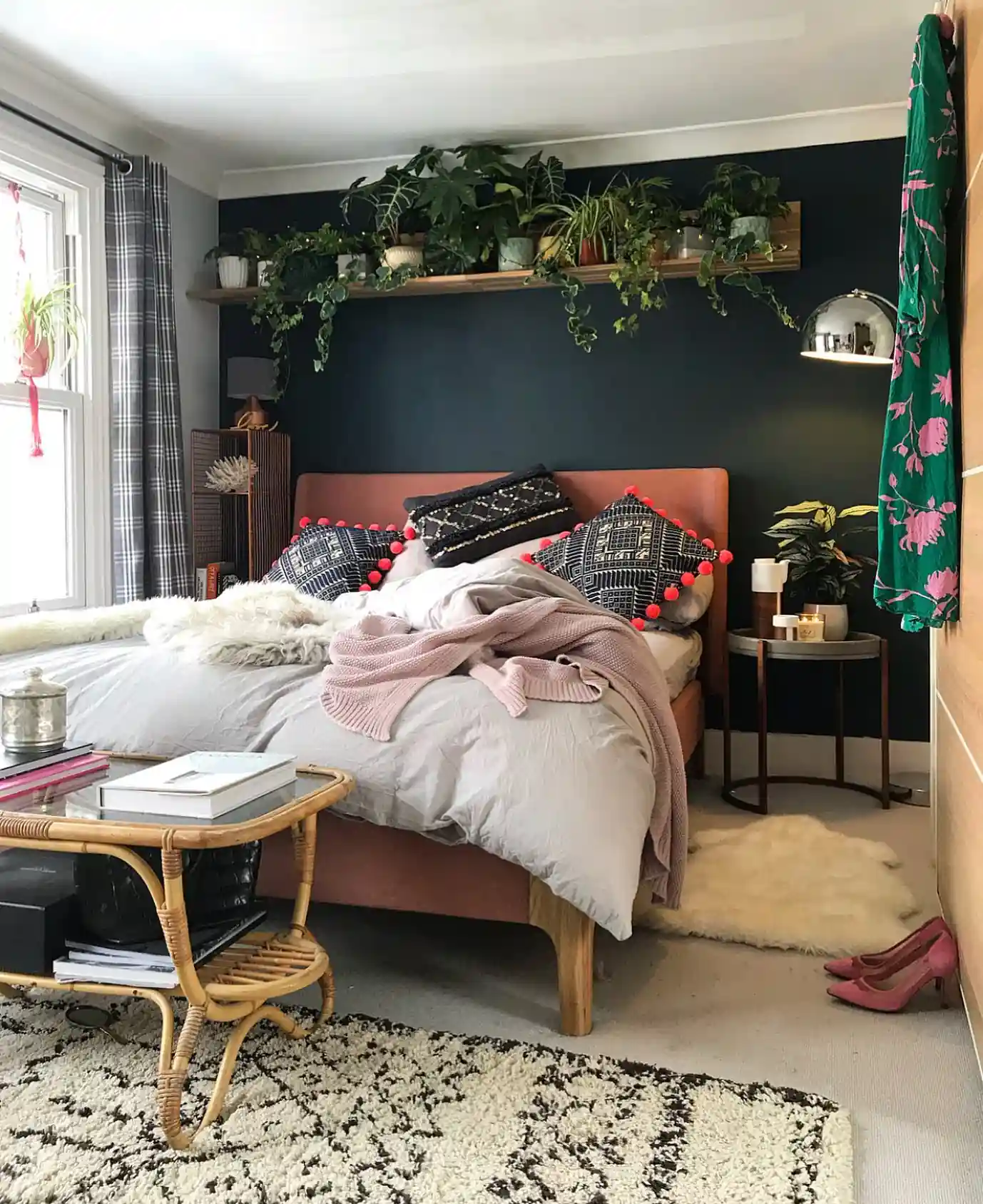
Plenty of people avoid a dark bedroom because they think it means living in a grey box.
This room argues otherwise. The wall behind the bed is deep teal, and everything in front of it is loud: a rust velvet headboard, black and white cushions edged in red pom poms, a dusty pink knit throw, a sheepskin, and a long shelf of trailing plants above the bed.
What the dark wall actually gives you:
- A backdrop that makes brighter colours look richer rather than fighting them
- Less bounce at 10am, which is the whole point
- Somewhere for your eye to rest in a room full of things
💡 Quick Tip
Put your brightest, busiest pieces against the dark wall rather than on the pale ones. The contrast reads as deliberate, and the pale walls stay quiet.
18. Watch Where Your Mirrors Are Pointing
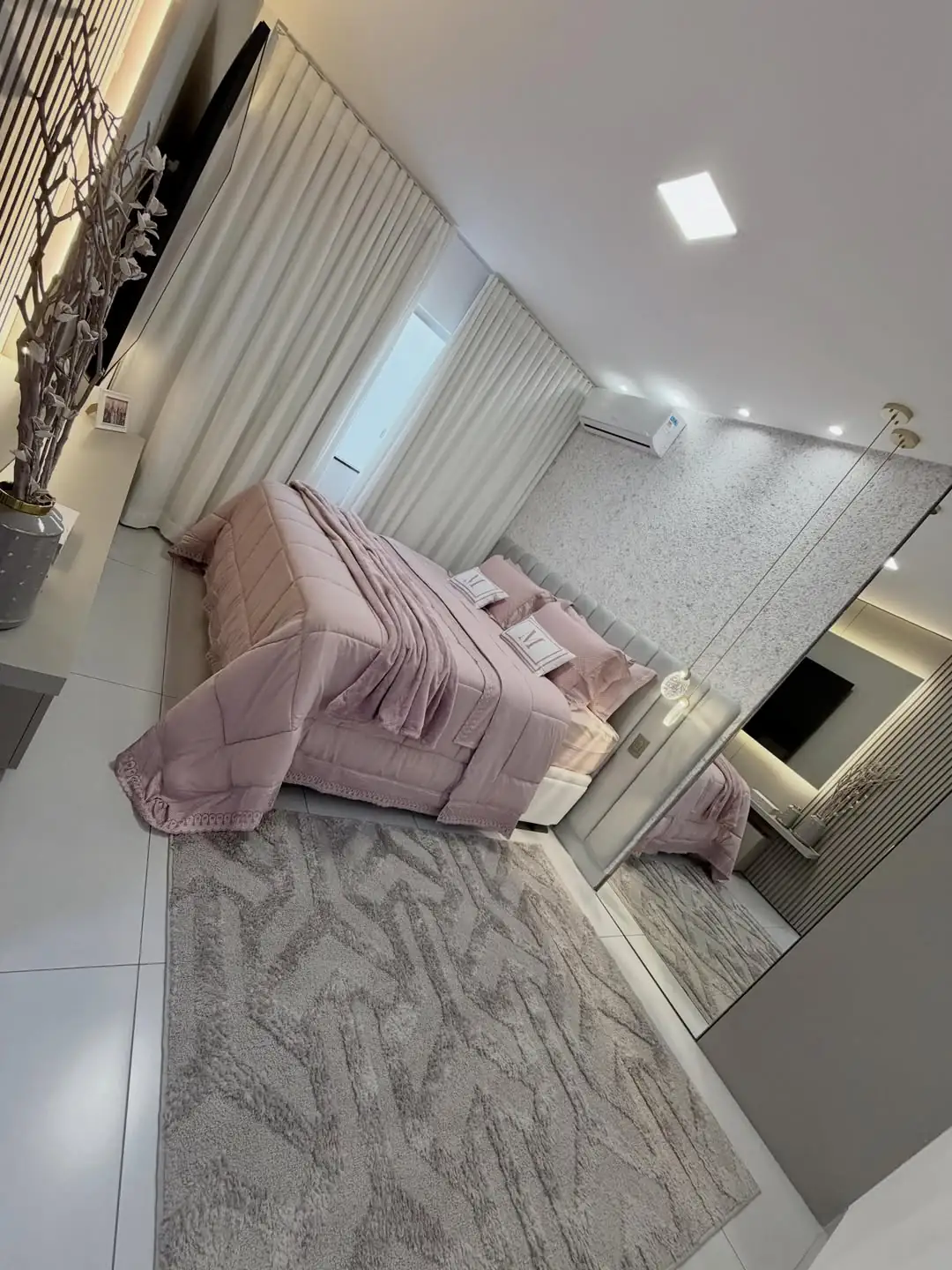
Mirrors make small rooms feel bigger. They also throw daylight straight back across the bed.
A full mirrored wall runs the length of this room, facing white vertical drapes at the window. Everything else is pale: white tiled floor, blush bedding, cream headboard, light grey rug. The mirror is effectively doubling whatever light gets past the curtains.
Where to put a mirror in a day sleeper’s room:
- On the same wall as the window, so it faces away from the glass
- Behind a door, or inside a wardrobe
- Above a dresser, angled downward rather than across the room
- Anywhere except directly opposite the window
19. Sheer Curtains Alone Will Not Get You Through a Shift
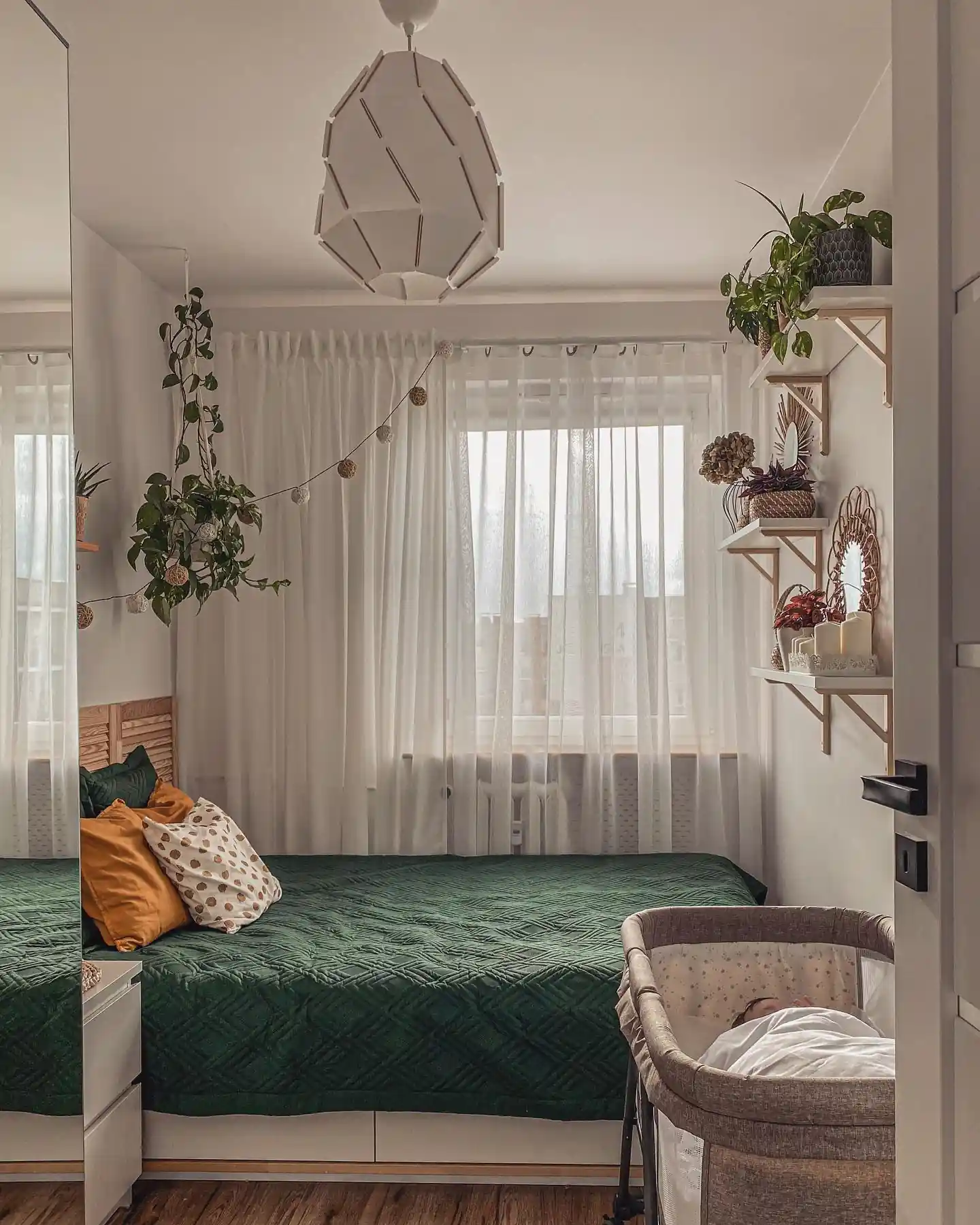
A reality check, and a room many nurses will recognise.
White walls, white ceiling, a full wall of sheer white curtains, and a bassinet beside the bed. Daylight pours straight through the sheers and reflects off every pale surface. Lovely for a nursery. Impossible for someone who needs to be asleep at eleven in the morning.
If this is close to your room, the order to fix it in:
- Add a blackout layer on a second track behind the sheers
- Swap the pale bedding for something darker, at least on your side
- Move the bed out of the direct line between window and pillow if the layout allows
- Keep the sheers, they still soften the room when you are awake
Sheers on a front track for daytime privacy.
A wall-width rail, which gives room to add a second layer.
Sheers as the only window layer.
White walls plus white ceiling plus white curtains, all bouncing at once.
20. Build the Bed Into a Wall Away From the Window
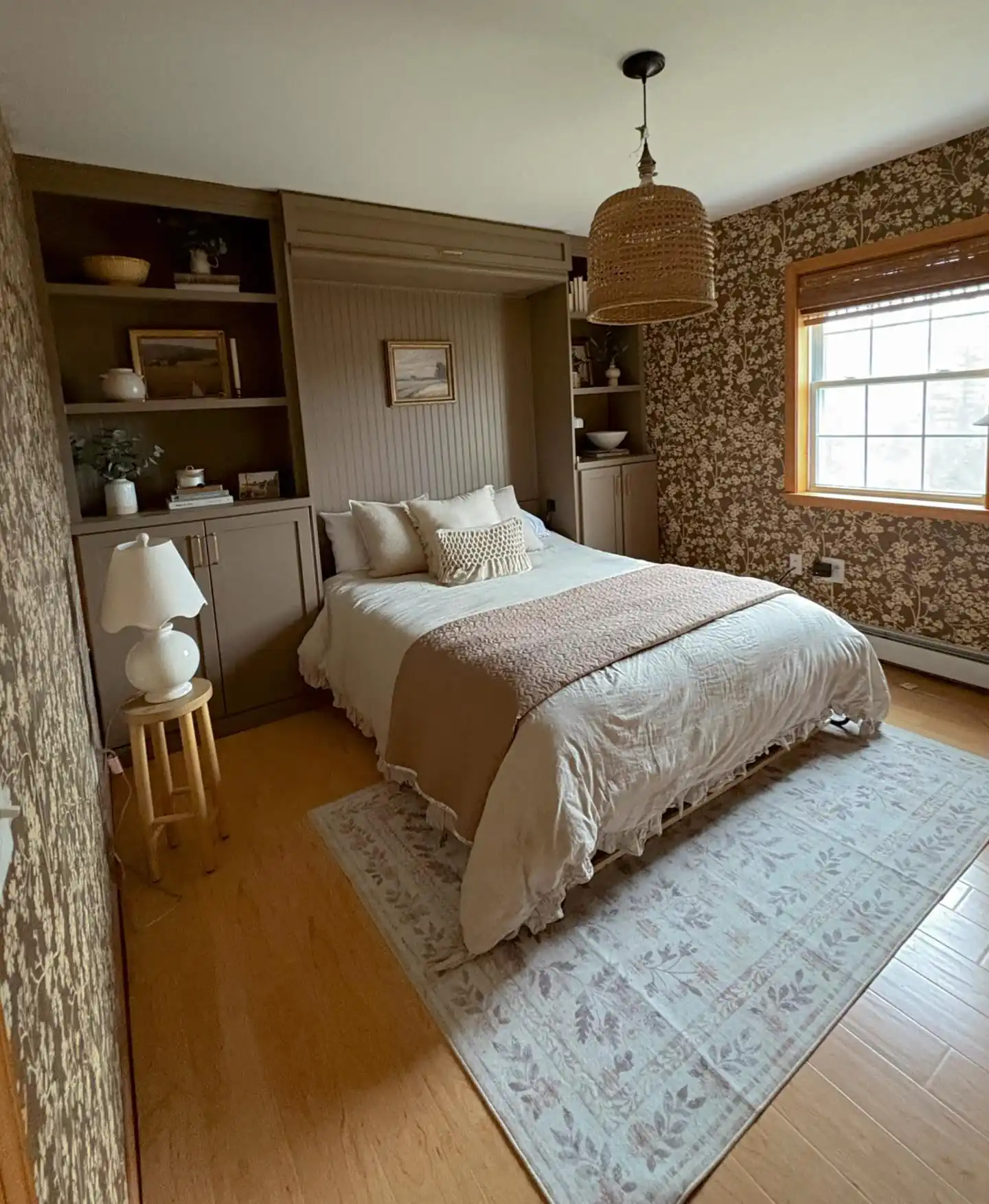
Sometimes the answer is not treating the window. It is moving the bed.
This room has a built-in unit with shelving on both sides and a recessed alcove where the bed sits. The window is on the adjacent wall, fitted with a woven roman shade. Because the bed is tucked into that recess, the joinery blocks direct light before it reaches the pillow.
The brown floral wallpaper matters more than it looks. Busy dark patterns absorb light in a way flat pale walls never do.
Find the wall your window does not sit on, and put the head of the bed there.
Put something tall on either side. Shelving, a wardrobe, even a bookcase works.
Treat the window normally. It no longer has to do all the work alone.
Costs nothing if you already own the furniture. Worth trying before you spend on anything else.
21. Put the Bed on the Floor and Away From the Glass
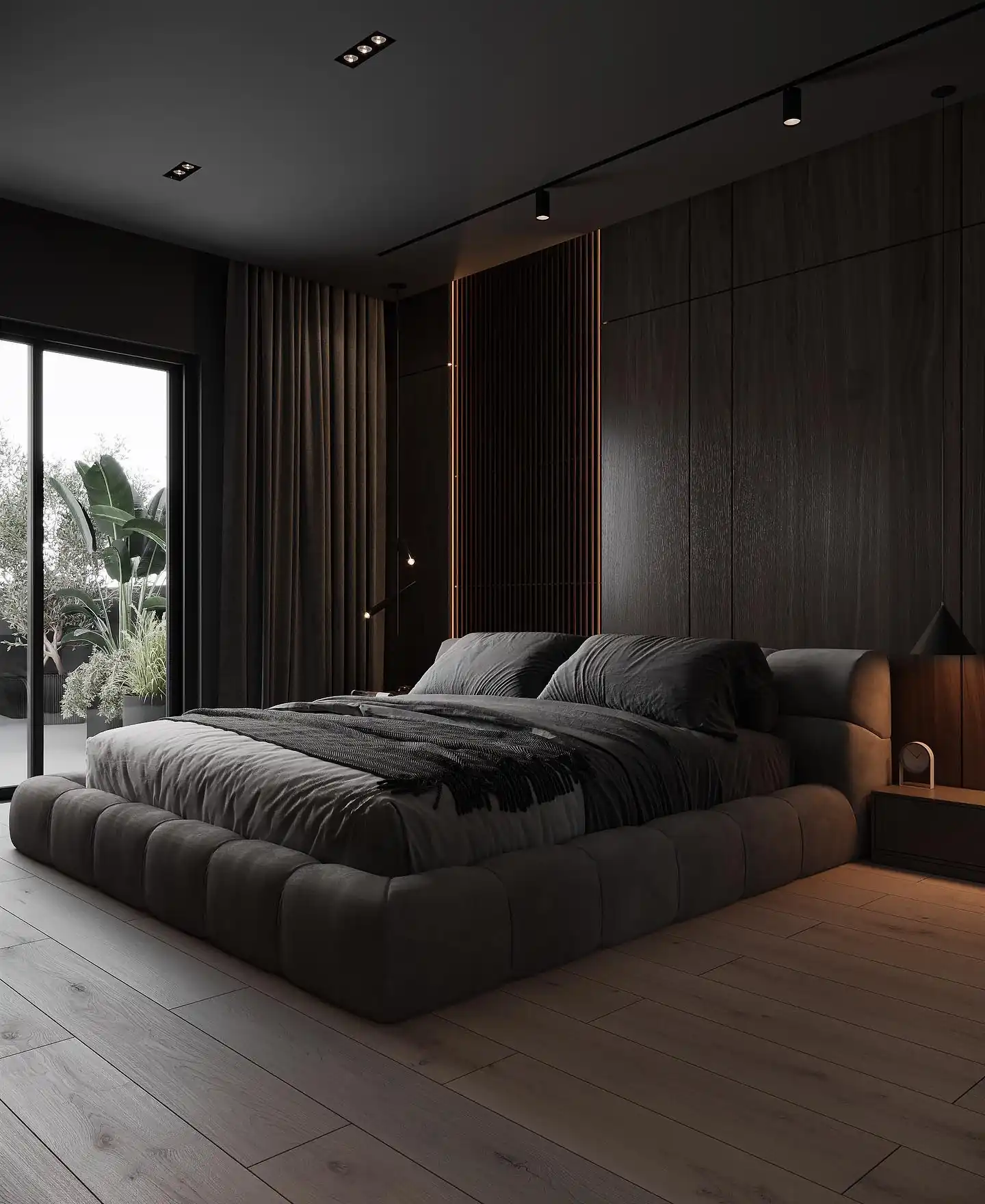
Lower bed, lower sightline, less light in your face.
A deep upholstered platform bed sits almost at floor level here, against a full wall of dark timber panelling and well back from the sliding glass door. Even with that much glass, the pillow end sits in the darkest part of the room.
The wall behind adds one more trick: a slatted panel with a warm light hidden behind it, so the only illumination near the bed comes from below and behind.
Three things worth stealing:
- A low bed keeps your head under the level of most window light
- The head of the bed goes against solid wall, never against glass
- Warm backlighting behind slats replaces anything overhead
Light travels in straight lines. Lower your head below the path between the window and the wall behind you, and a good deal of the problem solves itself before you buy anything.
22. Hang Curtains Around the Bed, Not Just the Window
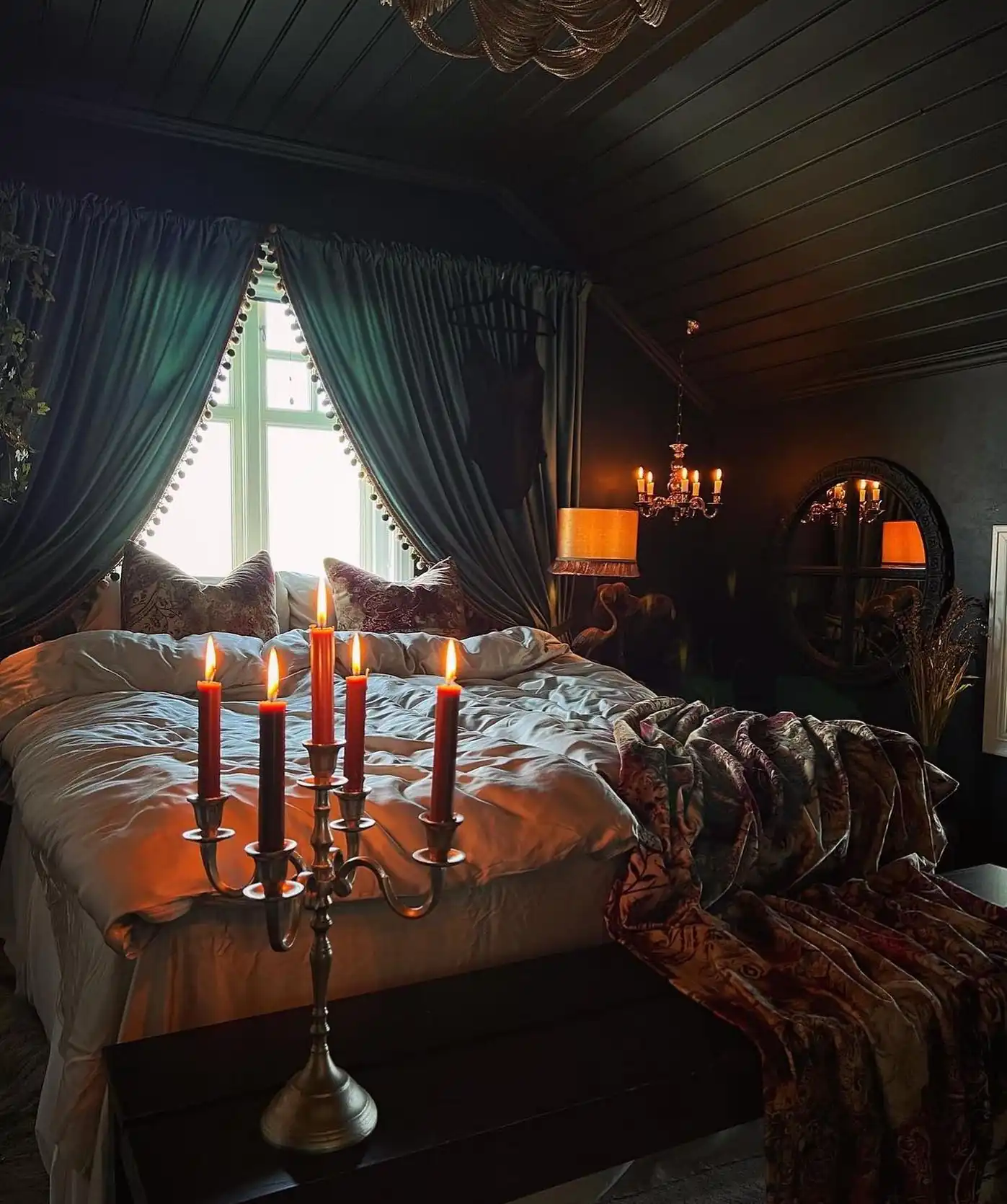
When the window sits in a sloped attic wall, treating it properly gets awkward. So this room treats the bed instead.
Deep teal velvet curtains with pom-pom trim are mounted above the bed and swept outward on both sides, framing the window behind. Draw them closed and the bed becomes its own small dark room, regardless of what the window is doing.
Pieces doing the work here:
- Velvet curtains with real weight, not cotton
- A rail or pole mounted to the ceiling above the bed
- Dark painted tongue and groove on walls and sloped ceiling
- Candles, a small chandelier and an amber shaded lamp for light at low level
An angled attic window that no standard curtain fits, letting light straight onto the pillow every morning.
Heavy drapes hung above the bed itself. The awkward window no longer has to be solved, only surrounded.
This suits attic conversions, dormers, and any room where the window shape defeats a standard rod.
23. When the Window Is Enormous, Darken Everything Else
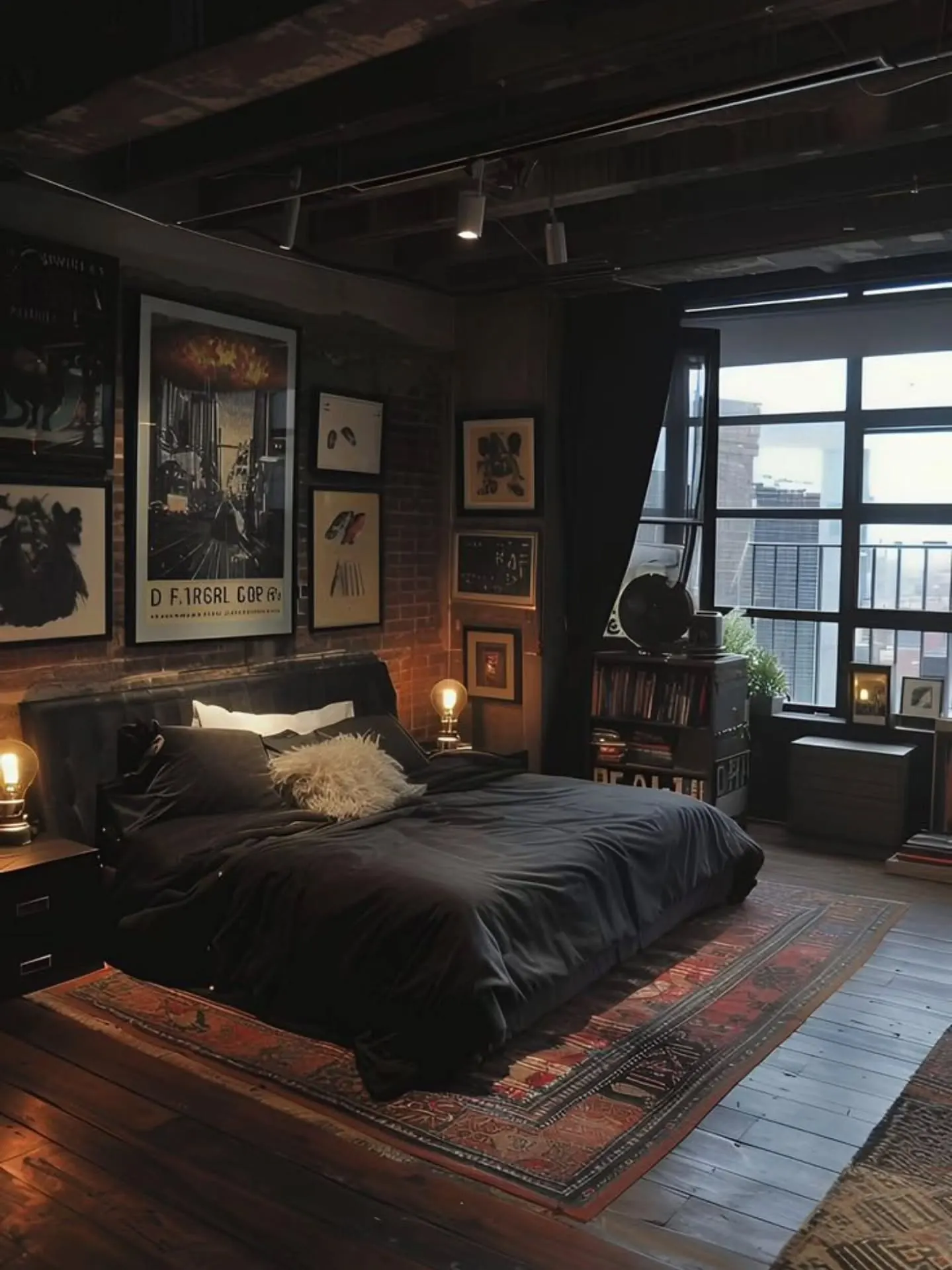
Loft windows are wonderful and they are a problem. This room accepts both.
A wall of black-framed glass runs the full height of the space, and there is only a single dark curtain panel to draw across part of it. So instead of fighting the window, the room darkens everything around it: exposed dark beams, black bedding, dark timber floor, and a wall of framed posters breaking up the brick.
Where the light is controlled instead:
- A dark headboard and dark duvet directly under the window’s reach
- Warm Edison bulbs on both nightstands rather than a ceiling fixture
- A layered vintage rug that absorbs rather than reflects
- Framed art filling the opposite wall, cutting down bare surface
Renting a loft usually means a ceiling track is your only option. Get quotes before you sign the lease.
24. Use Glow Instead of Overhead Light After a Night Shift
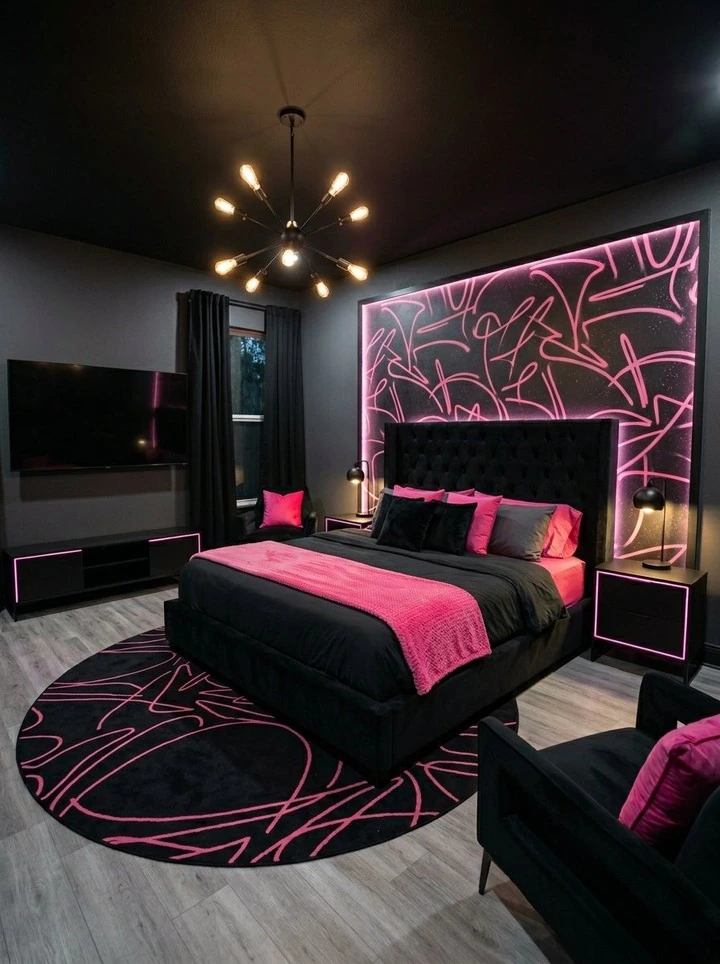
Dark walls plus a light source at eye level is a different experience from dark walls plus a ceiling bulb.
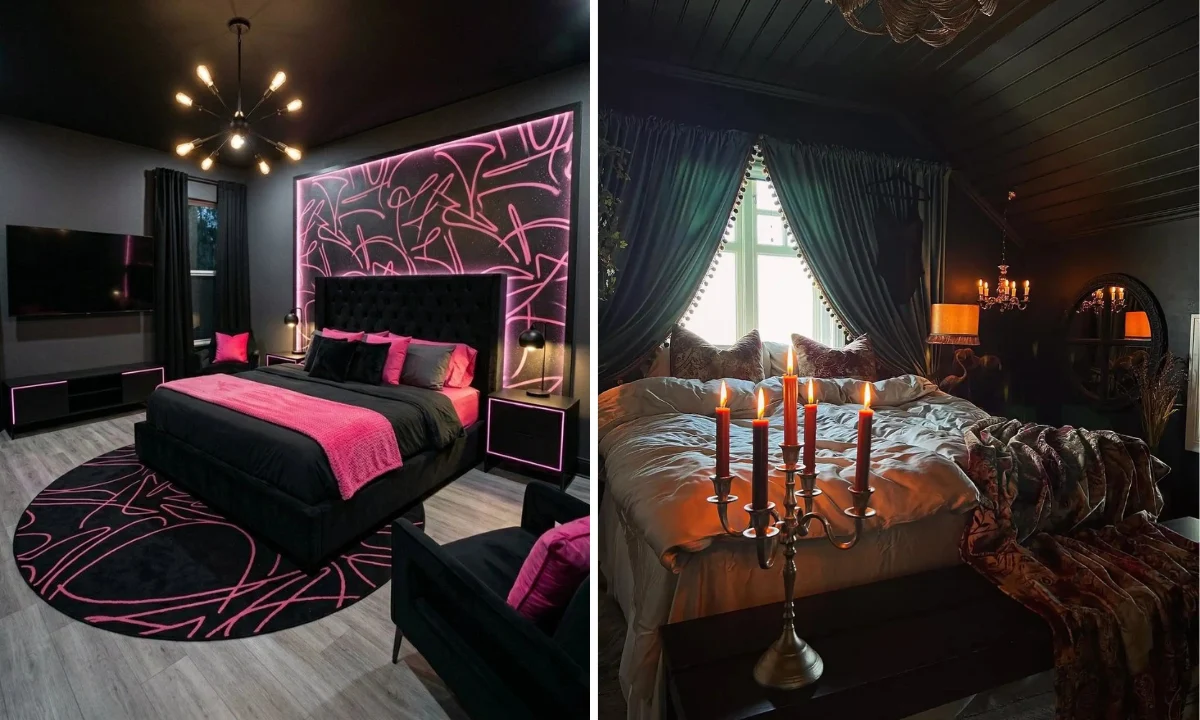
The room runs black on nearly everything: bed frame, headboard, nightstands, media unit, round rug. Then pink neon outlines the wall art, the furniture edges and the rug pattern, with a sputnik chandelier and warm bulbs above.
Strip the colour out of it and the principle still holds. Low, warm, indirect light tells your body the day is over, even when it is two in the afternoon outside.
📌 Good To Know
If neon is too much, LED strips behind a headboard or under a nightstand give the same effect in a warm white, and most of them run off a plug rather than needing wiring.
25. Hide the Light Source Inside the Ceiling
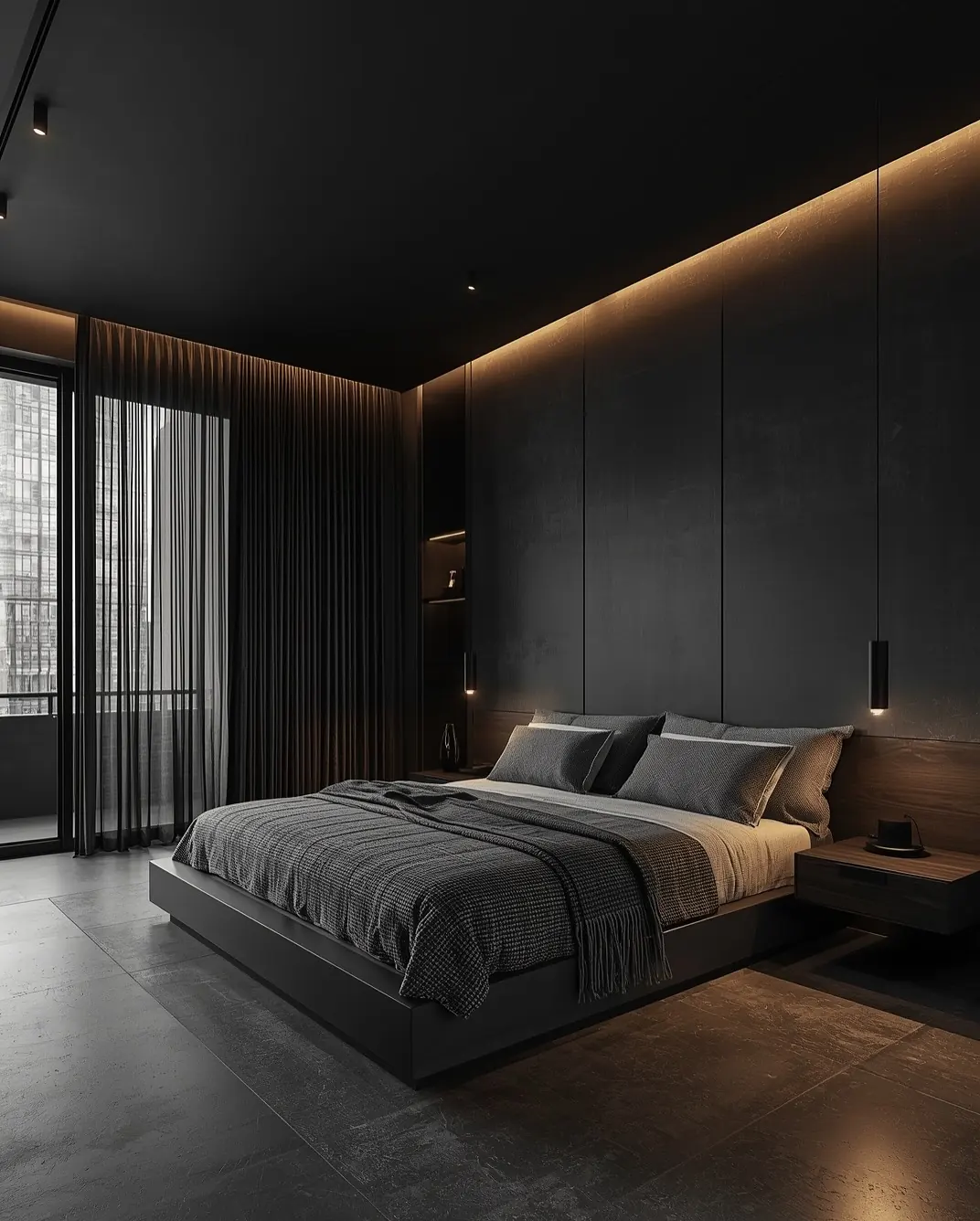
Nothing in this room glares, because nothing in it is a visible bulb.
A recessed channel runs where the dark panelled wall meets the black ceiling, throwing a warm wash downward. A slim pendant hangs beside the bed. The wall is full-height matt panelling with no white break anywhere.
The sheer dark curtain across the glass is the one weak point. It softens the view rather than blocking it, so a solid layer would need to sit behind.
| Where to hide a strip | What it gives you |
|---|---|
| Behind the headboard | Enough to read by, nothing in your eyeline |
| Under the bed frame | A safe path to the bathroom at 3am |
| Along a shelf edge | Ambient glow with no visible bulb |
Start With the Gap You Can Already See
You do not need all 25 of these. Most rooms have one weak point doing most of the damage, and it is usually the top of the curtain or the pale ceiling nobody thinks to paint.
Lie on your bed at midday and look around properly. Whatever bright line you notice first is where to start.
The cheapest fixes here cost nothing at all. Move the bed. Turn the mirror. Wrap the curtain behind the rod. Do those before you spend on anything, because they might be enough.
Save this for the next time you are staring at the ceiling at ten in the morning, working out what to change.
