

Four days off sounds like a lot until you have lived one.
Day one you sleep until 2pm and wake up foggy. Day two you finally do laundry, groceries, and the pharmacy run, and it takes six hours. Day three you mean to see someone, but you are behind on everything so you clean instead. Day four you start dreading the next stretch around lunchtime.
Then you are back on the unit telling someone you did not really get a break.
Knowing how to split your days off as a nurse is what fixes this. Not a longer break. Not better time management in some vague sense. A plan where each day already has a job before the stretch even ends.
The reason it works is that it removes the daily decision. You are not standing in your kitchen at 11am wondering whether today should be a rest day or a catch-up day. The answer was decided on your last shift, when you still had the clarity to make it.
This takes about 20 minutes to set up the first time and about five minutes before each stretch after that. No apps required. No color-coded planner.
By the end you will have a four-day split that protects your sleep, contains your errands, and leaves at least one full day that belongs to you.
- A notes app or a small notebook
- A whiteboard, sticky note, or fridge magnet
- Your work schedule for the next month
- A running errand list you add to during the week
- A calendar app with reminders
- Reusable grocery bags kept in the car
- Containers for food prep
- A willingness to leave one day unplanned
1. Count Your Real Days Off, Not the Ones on the Schedule

Your schedule says four days. Your body says something else.
The morning after your last night shift is not a day off. You will sleep through most of it and spend the rest in a fog. Same with the evening before your next shift, which belongs to prep and an early bedtime.
Count what is actually usable. For most nurses on a 3×12 stretch, four scheduled days off come out to three real ones plus two half days at either end.
Planning for three instead of four is the difference between a split that holds and one that collapses by Tuesday.
2. Give Each Day One Job Before the Week Starts
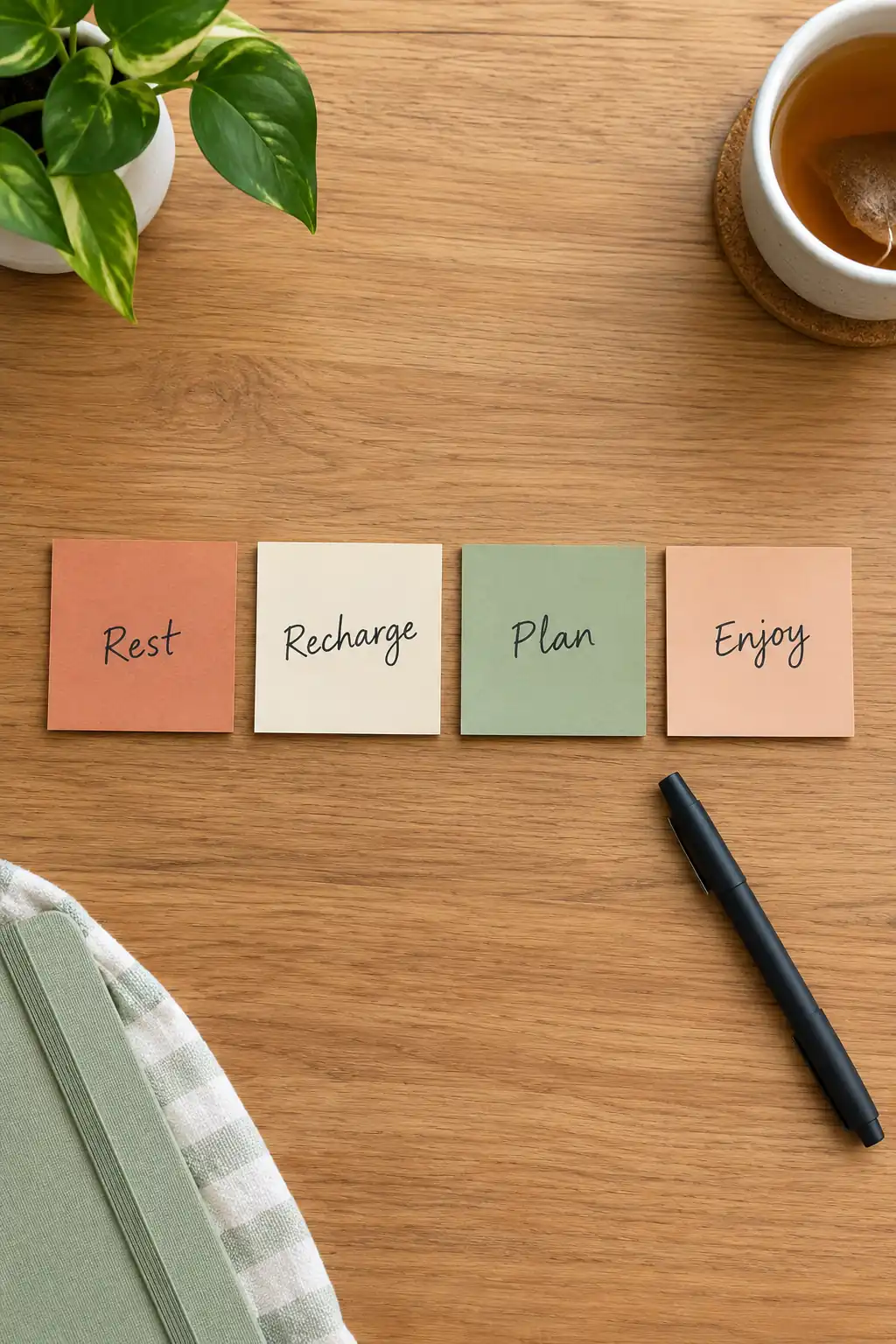
One job per day. Not a list. A job.
Day One recovers. Day Two handles errands and admin. Day Three is yours. Day Four resets and prepares.
The single job is what makes this work. When a day has one purpose, everything else that comes up has an obvious answer: it goes on a different day. Someone asks if you can help move a couch on your recovery day, and you already know the answer without agonizing over it.
3. Write the Split Somewhere You Will Actually See It

A plan in your head is not a plan. It is an intention, and intentions lose to a bad night of sleep.
Put it somewhere physical:
- A sticky note on the bathroom mirror
- A whiteboard on the fridge
- Four calendar events, one per day, titled with the job
- A note pinned to the top of your phone’s notes app
Four words is enough. Recovery. Errands. Life. Reset. You are not building a schedule, you are leaving yourself a reminder of a decision you already made.
Write it during your last shift, on a break, while you still have the clarity. By the time you get home you will not want to.
4. Protect Day One for Sleep and Nothing Else

Sleep debt after three twelves is real, and it does not clear itself in one night.
Whatever your body asks for on Day One, give it. If that is ten hours, take ten. If it is a full night plus an afternoon nap, take both. You are not being lazy. You are paying back a deficit that affects your judgment, your mood, and your immune system.
The one rule: no alarm unless you have something genuinely unmovable. An alarm on Day One is borrowing from the recovery you are trying to do.
Coming off nights makes this more complicated, because your body clock is still inverted. The schedule flip guide handles that transition, and it fits inside Day One without changing the rest of the split.
5. Get Outside for 20 Minutes Before Noon

Sleeping all day and staying inside is how Day One turns into Day Two feeling identical.
Twenty minutes of outdoor daylight before noon anchors your body clock and pulls you back toward a normal rhythm. It does not need to be exercise. A walk to the end of the street, coffee on the porch, or sitting in the yard all count.
Cloudy days still work. Outdoor light on an overcast morning is many times stronger than anything indoors.
6. Cap Day One at One Small Task

Zero tasks is unrealistic. Most people cannot fully do nothing without feeling twitchy about it.
So pick one. A load of laundry. Unloading the dishwasher. Answering the two texts you have been avoiding. Something that takes under thirty minutes and makes you feel like the day was not a total write-off.
The cap is the point. One task, then you stop. The moment it becomes three tasks, Day One has quietly turned into Day Two and you have lost your recovery day.
If the mess in the house is what makes resting impossible, that is a signal to fix the systems rather than the day. A come-home routine stops the pile-up before it reaches your days off.
7. Stack Every Errand Into a Single Trip

The errands are not what drains you. The four separate trips are.
Keep a running list on your phone all week. Groceries, pharmacy, the package that needs returning, the oil change you keep pushing. By Day Two it is already written and you are not standing in the driveway trying to remember what you needed.
Then order the stops by geography, not by priority. Furthest point first, working your way back toward home, so you are never doubling back across town.
One trip. Two to three hours. Done before lunch if you leave by nine.
8. Batch Your Admin Into One 60-Minute Block

Bills, insurance calls, scheduling your own appointments, the form your kid’s school needed last week.
Set a timer for 60 minutes and work the list until it rings. Phone calls first, because those windows close in the afternoon.
What does not get done in the hour rolls to next stretch. That sounds like failure and it is not. The alternative is admin bleeding across all four days, which is exactly the pattern you are trying to break.
9. Prep Food for the Next Stretch

Hour three of a twelve is not when you want to be deciding what to eat.
Cook three lunches and three dinners in one session on Day Two afternoon, while you are already in motion from errands. Sheet-pan meals, a big pot of something, overnight oats for mornings. Portion into containers, label with the day, stack them in order.
This is the highest-return hour of your entire stretch. It protects your energy on shift, your budget, and the temptation to eat whatever is in the break room at 2am.
Getting your scrubs into the wash on this same day keeps everything on one track. The wash method runs while you cook, and the clean sets land in your closet return slot before Day Three starts.
10. Give Day Three to People and Plans

Here is the day the whole split exists to protect.
Recovery is done. Errands are handled. Nothing is pending. Day Three is the only one where you get to be a person instead of a nurse catching up on life.
Use it on purpose. Make the plan before the stretch starts, not the morning of, because an unplanned free day gets eaten by whatever shows up:
- Say yes to something before your shifts begin
- Put it in the calendar so it holds space
- Pick one thing, not four
The thing itself does not matter. Dinner with a friend, a hike, a movie you have wanted to see, a whole afternoon doing nothing you can defend. What matters is that it was chosen rather than leftover.
11. Reset the House on Day Four Morning

Coming home to a disaster after shift one is what makes the whole stretch feel worse than it is.
Give the morning 45 minutes, no more. Surfaces wiped, dishes cleared, floors of the rooms you actually use. Not deep cleaning. A reset so the house is neutral when you walk back in exhausted.
Keep it to the morning specifically. Day Four afternoon belongs to slowing down, and a cleaning session that runs until 4pm ruins that.
If your bathroom and entryway are set up well, this reset is closer to fifteen minutes than forty-five.
12. Set Up Shift One the Night Before

Everything that touches tomorrow morning gets handled tonight.
Scrub set pulled and hanging. Bag packed. Food containers moved to the front of the fridge. Alarms set and phone charging. Shoes and socks where you will find them in the dark.
Then go to bed earlier than feels necessary. An hour before your usual is about right, because the first night of a stretch is the one your body fights hardest.
A wind-down routine makes that earlier bedtime actually work instead of turning into an hour of staring at the ceiling. And a blacked-out bedroom matters here too, especially if you are heading into nights and going to sleep while it is still light out.
Avoid These 5 Mistakes That Collapse the Split
Questions Nurses Actually Ask About This
What This Looks Like After a Few Rotations
20 min outdoor light
One task, 30 min cap
60 min admin block
3 lunches, 3 dinners
Booked in advance
Nothing pending
Bag and scrubs ready
Bed one hour early
Four Days, Four Jobs, One Decision
That is how to split your days off as a nurse without any of it depending on willpower. The decision gets made once, on a break, in about five minutes.
What you are protecting is not really the four days. It is the version of yourself that walks back onto the unit on Monday.
Write your split before your next stretch ends. Pin this so it is there when you do.
