
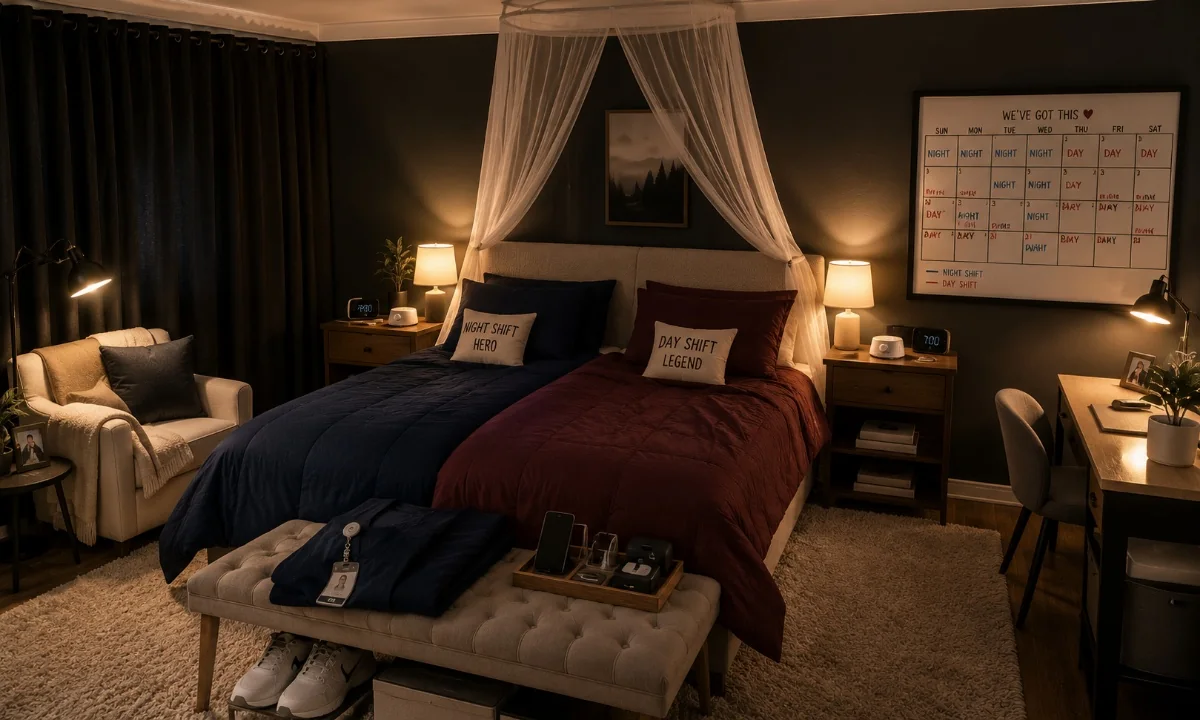
Loving someone whose schedule never lines up with yours is its own kind of hard. One of you is climbing into bed as the other laces up for a shift, and the mattress rarely holds you both at the same time. The bedroom stops being a shared retreat and starts feeling like a relay handoff, where every creak, every light, and every alarm risks stealing the sleep a night-shift body needs.
These bedroom ideas for nurse couples fix the small frictions that add up over a week of missed overlaps. Some protect sleep directly, like blackout canopies, silent alarms, split duvets, and a quiet door. Others carve out space so the awake partner can live normally, with a reading nook, a corner desk, or a TV wall that never lights up the sleeping side.
A few are just about staying close, like a shared shift calendar and a spot to leave each other notes. Pick the ones that match your space and your schedules, and build a room that lets you both rest and still feel like a team.
1. Sleep in Two Separate Beds for True Independence

When your shifts never line up, sharing one mattress means every entrance and exit ripples across to the other side. Two separate beds end that for good.
This coastal room shows how to make it look planned, not clinical. Matching cane headboards, a shared nightstand between them, and one calm color story tie the two beds into a single design.
How to make twin beds work for a couple:
- Push two twin or twin XL beds together, or leave a small gap with a shared nightstand between
- Match the headboards and bedding so the pair reads as one set
- Give each bed its own lamp and its own blackout control
You still share the room and the wind-down, you only stop stealing each other’s sleep.
Match the two beds so the room looks designed, not like a hotel.
Keep a shared nightstand between them for a sense of togetherness.
Squeezing a light sleeper onto the aisle side of one shared bed.
Mismatched frames that make the room feel thrown together.
2. Give Each Person Their Own Duvet

Shared covers turn every shift change into a tug of war. One person slides out of bed at 6 a.m. and the other loses the whole comforter.
The two-duvet method fixes it. Instead of one big cover, each of you gets your own.
You also get to pick your own warmth, so a hot sleeper and a cold sleeper both stay comfortable.
Set up the two-duvet bed
3. Choose a Mattress That Splits Down the Middle
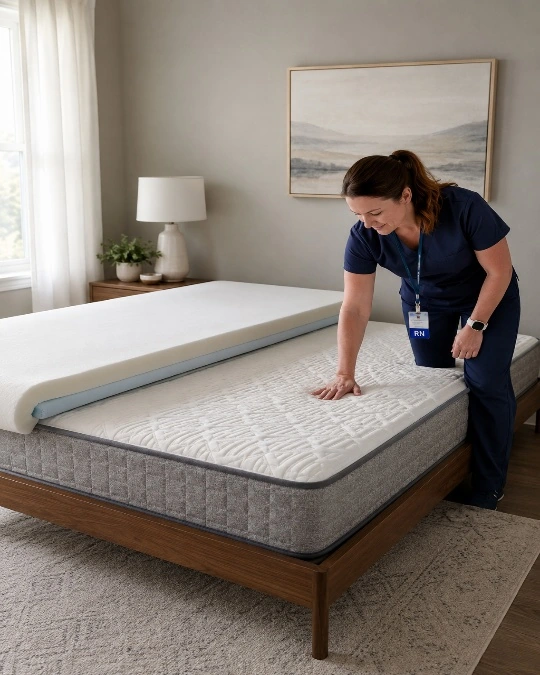
One of you sinks, the other floats. When two nurses share a bed but rarely sleep in it at the same time, a single firmness setting rarely fits both.
A split-firmness mattress solves it in three ways:
- Choose a bed with two firmness zones, soft on one side, firm on the other
- Look for strong motion isolation so a partner climbing in at midnight goes unfelt
- Add a topper to just one side if a full new mattress is out of budget
Each of you gets the support you need without a nightly compromise.
4. Put the Early Riser on a Low or Floor Bed

Climbing out of a tall bed jostles the whole mattress and the sleeper with it. A lower sleep surface on the leaver’s side cuts that motion way down.
Lower the exit, soften the wake-up:
- A platform or floor bed the early riser can roll off without bouncing
- The night worker on the side closest to the door
- A soft rug underfoot so bare feet make no sound on the floor
Put the partner who leaves first on the door side of the bed.
Lower that side or use a floor bed to shrink the climb out.
Lay a soft rug at the exit so steps stay silent.
5. Wrap the Room in a Dark, Moody Palette for Day Sleep

A room painted soft white bounces daylight everywhere, which is the last thing a day sleeper needs. This bedroom goes the other way, with deep charcoal walls, a black upholstered bed, and dark bedding that soak up light instead of throwing it back.
The dusty pink layers keep it warm, not gloomy. And the two matching lamps mean each partner gets their own low light without flipping a bright switch. It leans on the same logic behind calming bedroom color choices.
What makes the dark scheme work for opposite shifts:
- Deep wall color keeps the room naturally dim at any hour
- Dark bedding hides the glow that pale linens catch from window gaps
- Warm pink accents stop the room from feeling heavy
The darker the surfaces, the easier it is for one of you to sleep while the sun is high.
Bright white walls and pale bedding bounce every bit of daylight around the room.
Deep charcoal walls and dark bedding soak up the light so a day sleeper stays under.
6. Layer Sheer and Heavy Curtains to Control the Light

Day sleepers and awake partners want opposite things from a window. One needs pitch black, the other wants to see. A double curtain setup lets the same window do both jobs.
This glam bedroom shows the layered look, with soft sheers behind heavier drapes on a double rod.
Here is how the two layers split the work:
| Sheer layer | Heavy layer |
|---|---|
| Soft daylight for the awake partner | Full darkness for the day sleeper |
| Privacy without blocking the view | Pulled shut the moment someone sleeps |
Pull only the sheers by day, close the heavy pair when it is someone’s turn to sleep.
💡 Quick Tip
Mount the rod wide enough that the heavy panels stack fully off the glass when open. That way the awake partner gets the whole window, and nothing blocks the light they want during the day.
7. Split the Lighting So One Can See While the Other Sleeps
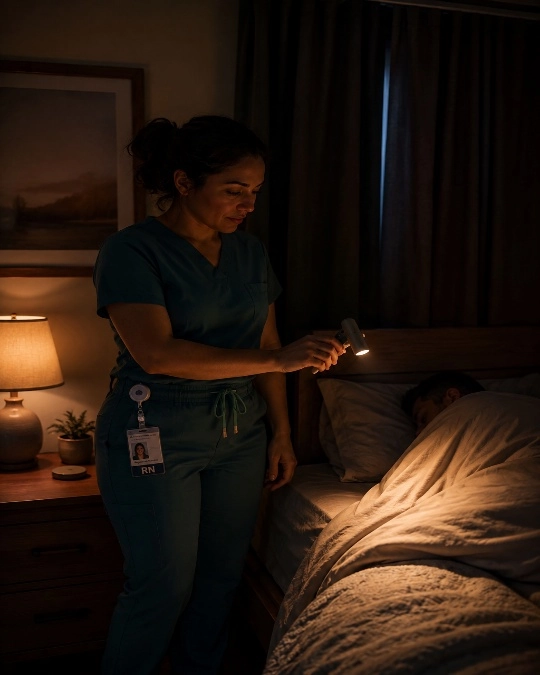
When one of you walks in at 7 a.m. and the other is dead asleep, the overhead light is the enemy. You need a way to move around without flooding the room.
Set up two light zones that never wake the sleeper. Amber or red-toned bulbs matter most here, since they barely touch melatonin even if a lamp clicks on nearby:
- Put a warm, low lamp on each side so neither of you reaches for the ceiling switch
- Add motion night lights near the floor to light the path to the closet or bathroom
- Keep a small clip-on reading light with a warm bulb for the partner still awake
The sleeper stays in the dark, the waker still sees. Everyone wins.
8. Build a Blackout Canopy Around the Bed

Studio apartment or a shared room with one big window? Build a dark pocket around the bed itself instead of trying to black out the whole space.
A canopy gives the sleeper a cocoon while the other person still uses the room in daylight, and it pairs well with the rest of your blackout bedroom ideas:
- A ceiling-mounted frame draped with blackout fabric panels
- Heavy curtains hung on a track that circles the bed
- A four-poster frame wrapped in dark, dense material
- Clip-on blackout liners you can pull back when the room is shared
One side sleeps in the dark, the other side keeps the blinds open.
⚠️ Watch Out
Do not seal the canopy on all four sides in a warm room. Air stops moving and it gets stuffy fast. Leave a hand-width gap at one end so fresh air still reaches the bed.
9. Silence the Door With a Sweep and Soft Latch
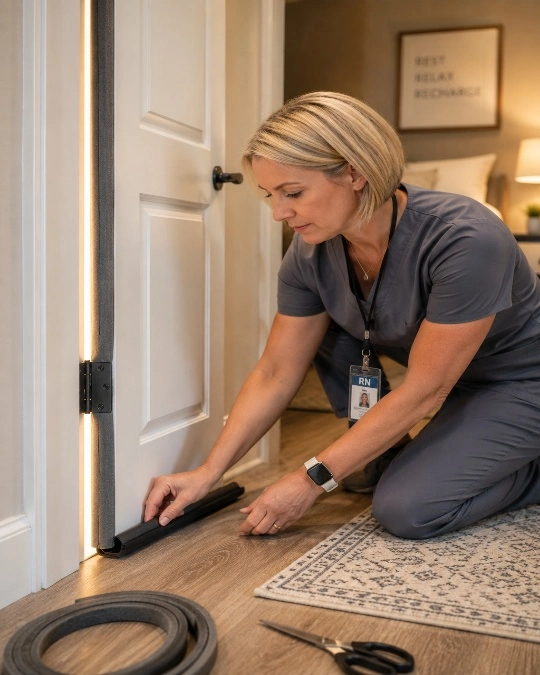
The door is the loudest thing in an opposite-shift bedroom. Every time one of you comes or goes, the click of the latch and the draft of hallway light reach straight to the pillow. The same fixes carry over from soundproofing the whole room.
Quiet the whole doorway in three moves:
- Stick a foam weatherstrip around the frame to block the light line and muffle sound
- Add a door sweep along the bottom so hallway noise and glare stop sliding under
- Press a felt pad or silicone bumper on the latch so it closes with a soft touch
The partner heading out slips through, and the one asleep never registers the door at all.
Weatherstrip the frame and add a sweep to kill light and sound.
Add a soft bumper so the latch settles instead of clacks.
A lock or latch that clicks loudly to confirm it shut.
Leaving the under-door gap open to hallway light.
10. Swap the Loud Alarm for a Silent One

Nothing wrecks day sleep faster than a partner’s 5 a.m. alarm blaring across the room. One of you jolts awake for no reason at all.
A silent alarm wakes only the person who needs it:
- A vibrating wristband alarm that buzzes just the wearer
- An under-pillow vibrating pad tucked on one side
- A phone on vibrate, slipped under the leaving partner’s pillow
- A smartwatch set to a gentle tap alarm
The one heading to work gets up on time. The one still sleeping never hears a thing.
📌 Important Note
If missing a shift is a real risk, test the silent alarm for a few days before you trust it fully. Keep a quiet backup alarm across the room as a safety net while you get used to it.
11. Set Up Two White Noise Zones

Steady sound is a day sleeper’s best friend, but the partner who is awake and moving through the home needs to hear normal life. One machine cannot do both jobs.
Build two separate sound zones and let each side do its own work:
| Sleeper zone | Waker zone |
|---|---|
| A machine aimed at the bed, set to brown noise | A softer sound near the living space |
| A fan for steady sound plus airflow | Earbuds with a playlist on noisy days |
Brown noise masks door thuds and voices better than the higher hiss of standard white noise.
Two sound zones let one partner stay wrapped in even, sleep-friendly noise while the rest of the home carries on at a normal volume.
12. Keep the Sleep Zone Scent-Free and Neutral

Smells wake people as easily as sound does. When one partner cooks breakfast after a night shift while the other is three hours into day sleep, kitchen and coffee smells drifting in can pull the sleeper right up.
Protect the air around the bed and keep the sleep zone neutral:
- Keep strong scents like coffee, food, and perfume out of the bedroom entirely
- Run a quiet air purifier near the sleeping side to keep the air fresh and even
- Skip heavy plug-in fragrances and candles that linger while someone sleeps
- Crack a window between sleep shifts to clear the room before the next person rests
Clean, neutral air keeps the sleeper down while the other moves through a normal morning.
Run a quiet purifier and close the door before cooking.
Air the room out between sleep shifts.
Plug-in fragrances and strong candles near the bed.
Cooking smells drifting into an open bedroom.
13. Stock Each Nightstand for a Different Sleeper

A nurse leaving for nights and a nurse home sleeping days need totally different things within reach. Sharing one cluttered nightstand serves neither. A calm, purposeful nightstand setup on each side makes the difference.
Treat the two sides as separate stations:
| Day-sleeper side | Night-worker side |
|---|---|
| Sleep mask, earplugs, water | Silent alarm, badge, hand cream |
| Amber lamp, white noise remote | Charging pad, small task light |
Each side holds only what that person reaches for, so no one fumbles in the dark on someone else’s clutter.
Give each side its own kit
14. Move the Getting-Ready Routine Out of the Bedroom

The partner leaving for shift should never have to dig through a dark closet. Every drawer that opens and every hanger that scrapes pulls the sleeper closer to waking.
Move the whole routine out of the room:
- Lay out scrubs, badge, and shoes in the bathroom or hallway the night before
- Keep a charging tray by the door for phone, watch, and keys
- Dress and get ready outside the bedroom, then slip out quietly
html
Prepping outside the bedroom means zero rummaging, zero light, and zero noise near the person trying to sleep through the day.
15. Park a Storage Bench at the Foot of the Bed

The partner coming off shift needs somewhere to land that is not the edge of the bed by their sleeping partner’s head. This farmhouse setup answers that with a cushioned trunk at the foot of the bed.
It pulls double duty. The padded top is a spot to sit and pull off shoes, and the closed storage inside holds spare blankets or an off-shift bag. Pick one with a soft-close lid, since a hard lid dropping shut is exactly the kind of sharp sound that wakes a day sleeper.
Why the foot of the bed is the right spot:
- It sits far from the pillows, so sitting down never jostles the sleeper
- Closed storage keeps gear off the floor and out of sight
- A soft top gives the leaving partner a quiet place to dress
Set it up once and both of you have a calm handoff zone every shift after.
16. Tuck a Reading Chair by the Window

The bed should not be the only place to land when your partner is asleep in it. This sage cottage room solves that with a soft armchair set by the window, a little island away from the pillows.
Give the awake partner a spot of their own:
- Place a comfortable chair near the window, well away from the sleeping side
- Add a small side table for tea, a book, or a phone
- Keep a warm floor lamp or a wall sconce nearby for low reading light
The awake one relaxes in their own corner while the sleeper stays undisturbed a few feet away.
💡 Pro Tip
Stock the nook with everything the awake partner needs for an hour off, a book, a charger, a folded throw. The fewer trips across to the bed side, the fewer chances to wake the person sleeping.
17. Fit a Compact Desk in a Quiet Corner

Twin beds handle the sleeping, but this room adds what most couples forget: a real workspace. A small desk in the corner lets one partner chart, study, or handle life admin while the other sleeps close by.
Working at a desk beats working in bed for a light sleeper:
| Working in bed | Working at a corner desk |
|---|---|
| Screen light spills across the sleeper | A task lamp keeps the light on the desk |
| Every shift of the laptop jostles the mattress | No movement anywhere near the sleeping side |
Point the desk at the wall or window, not the bed, so the glow never reaches the pillows.
A wasted corner piled with scrubs, bags, and chargers nobody wants to sort out.
A compact desk with a task lamp and a chair, quiet enough to use mid-sleep.
18. Mount the TV and Layer the Lighting

When one of you is winding down and the other is fast asleep beside them, a quiet screen and soft light let you unwind without lighting up the whole room. This modern setup leans into that with a wall-mounted TV facing the bed and warm cove lighting tucked into the ceiling.
The layers matter here. A hidden LED strip and a low pendant give off just enough glow to move around, while the main lights stay off.
What makes this work for an off-sync couple:
- A wall TV the awake partner can watch low with headphones
- Cove and pendant lighting that never floods the sleeping side
- A slim media console that keeps clutter off the nightstands
The awake partner gets real downtime, the sleeping one gets darkness.
19. Tie the Room Together With One Calm Palette
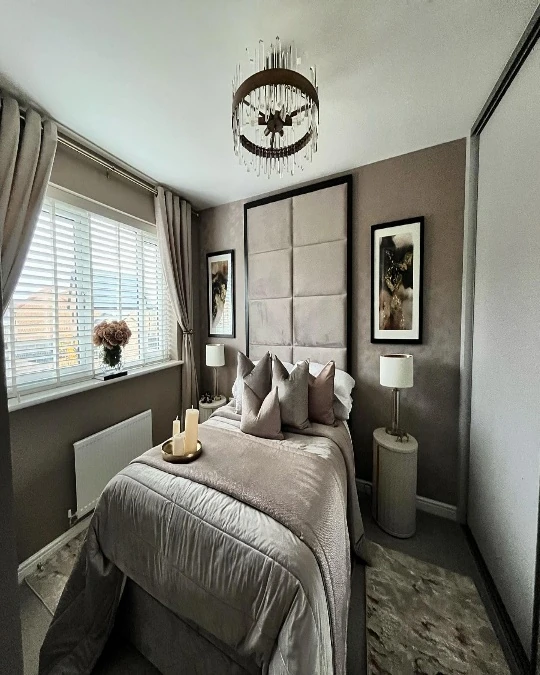
Two people running opposite clocks can turn a bedroom into a cluttered mess of two lifestyles. A single soft color story keeps the shared space calm no matter who is coming or going.
This room leans on warm greige walls, a tufted headboard, and muted bedding for a look that feels settled and quiet.
Build a calm shared palette in three moves:
- Pick one neutral base like greige, taupe, or soft grey for walls and bedding
- Keep both nightstands and lamps in the same tone so neither side clashes
- Add a couple of soft accents you both like, nothing loud or high-contrast
20. Soften the Room With Plush, Layered Textures

Some rooms you sink right into. This glam bedroom earns that with layered shag rugs, quilted blush bedding, and a fireplace glow that makes winding down feel like a reward after a long shift. It works even better paired with a calm decompression corner elsewhere at home.
For a couple on opposite clocks, all that soft material pulls a second duty beyond looking good:
- Layered rugs underfoot that soften footsteps near the sleeping side
- Quilted bedding and a blush throw for a bed you want to climb into after nights
- A fireplace and candles for warm, low light instead of a bright overhead
- Heavy velvet curtains that add weight and help hold back daytime light
The one coming home gets a cocoon, the one still up gets a calm place to sit.
A room full of soft, warm textures muffles the small sounds of a partner moving around and gives the one who is off shift a retreat worth coming home to.
21. Hang a Shared Shift Calendar You Both See
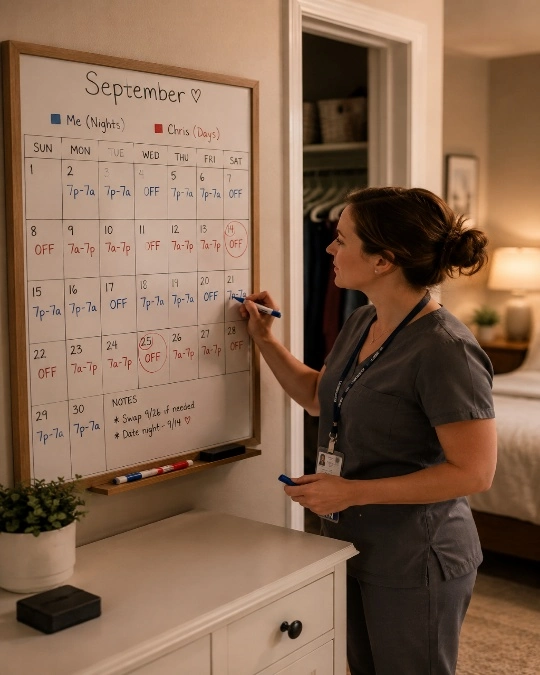
Opposite schedules mean you can go days barely crossing paths. A visible calendar keeps you from feeling like roommates instead of partners.
Put your two schedules side by side:
- Mount a large wall calendar or whiteboard near the closet or door
- Color-code each person’s shifts so overlaps jump out at a glance
- Circle the rare hours you are both off and awake, then protect them
22. Leave Each Other Notes in One Little Spot
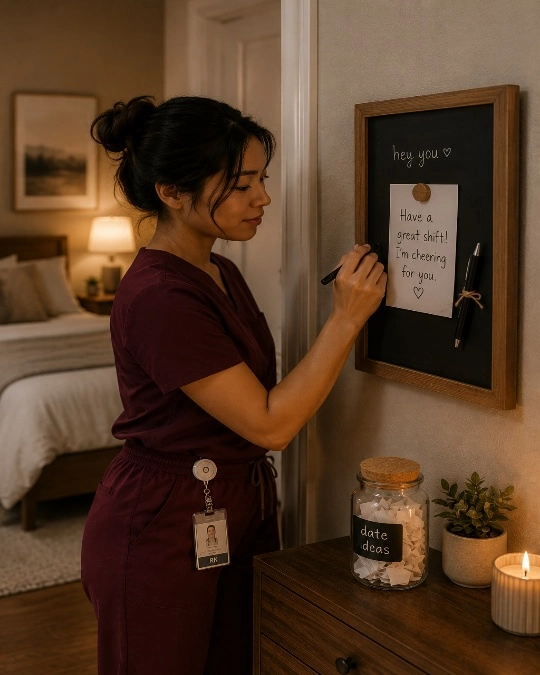
Opposite shifts mean you can go days trading the bed like a relay baton and barely speaking. A small, dedicated spot to leave each other a note keeps the connection alive when your waking hours never touch.
Make a handoff spot you will both actually use:
- Hang a small chalkboard or magnetic board by the door where you both pass
- Leave a short note before you crash or head out, a reminder, a thank you, a heart
- Tie a pen to the board so it never wanders off
- Keep a shared jar for date ideas to open on your rare overlapping day off
Build your connection corner
Build a Room That Lets You Both Rest
You do not have to try all 22 at once. Start with whatever steals the most sleep right now, the door, the alarm, or the light, and add another idea once that one sticks. In a room two people share on opposite clocks, small fixes add up fast.
The goal is simple. One of you sleeps deeply while the other lives their day, and you still feel like a team even when your waking hours barely touch.
Start Here Tonight
Pick one fix for the light, one for the sound, and one for staying close. Three small changes, and the room already works harder for you both.
Steady hands deserve a steady home, and that starts right here. Save your favorites to your bedroom board, and come back when you are ready to build the next piece.
