

It is 5:12am. Your shift starts at 7.
You are standing in front of an open closet holding a navy top that does not match any of the three navy bottoms hanging next to it. One pair is still damp. One has a broken drawstring you have been meaning to fix since March. The third is somewhere in the laundry basket under a towel.
This is the part of nursing nobody warns you about. Not the twelve hours. The eight minutes before them.
Learning how to organize a nurse’s uniform closet around a 3×12 rotation solves this at the root. Not with prettier bins. With a system that matches how you actually work: three shifts in a row, then four days off, then repeat.
The whole point is that you stop making decisions at 5am. Three complete sets hang ready. Your layering pieces have a shelf. Your shoes have a spot. And when clean scrubs come out of the dryer, they have a place to go that keeps the system running.
This takes about two hours on a day off. You need a handful of cheap supplies and a willingness to get rid of the pieces you keep skipping over.
By the end, your closet works on your schedule instead of against it.
- Slim velvet hangers (10 to 15)
- A second tension rod or hanging shelf organizer
- Two or three fabric bins or baskets
- A shallow tray or drawer organizer
- Shelf dividers (optional but helpful)
- A donation bag and a repair bag
- Adhesive labels or a label maker
- A small hook or adhesive hook strip
- A laundry basket for the sorting stage
- A trash bag for anything unwearable
- Pull every scrub piece out of the closet
- Sort into keep, retire, and repair piles
- Count your sets against your actual rotation
- Divide the closet into three zones
- Hang three complete shift sets in grab-and-go order
- Store backup sets on the second rod or shelf
- Give layering pieces their own shelf
- Set up a landing bin for shoes and compression socks
- Keep badge reels and pocket gear in one tray
- Add a return slot for clean scrubs from the laundry
- Reset the closet the night before your first shift
1. Pull Every Scrub Piece Out of the Closet

Everything comes out. Tops, bottoms, jackets, the warm-up you wore twice in 2023. Lay it all on the bed where you can see it in one view.
This feels like overkill for a closet that “just needs tidying.” It is not. You cannot build a system around pieces you cannot see, and half the problem is that some of your scrubs have been buried behind a coat for two years.
Empty closet, full bed. That is the starting line.
2. Sort Your Scrubs Into Keep, Retire, and Repair Piles
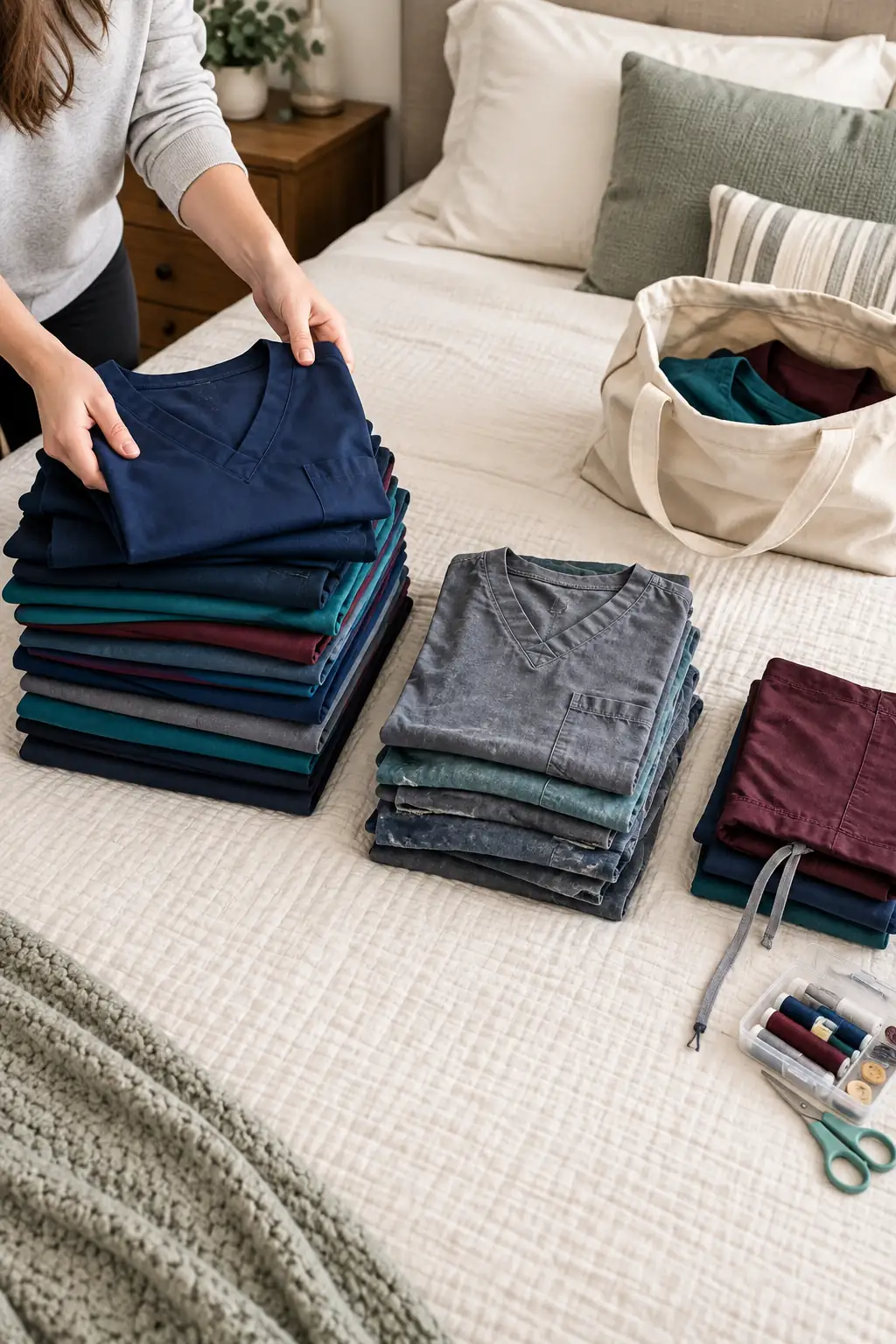
Three piles, and be honest with yourself on each one.
Keep is anything you would willingly wear on a Monday. Not “it still fits.” Not “it was expensive.” Would you reach for it first?
Retire is faded, pilled, stretched out, or stained past saving. If the color has gone gray-navy instead of navy, it is done. Donate what is still decent and bin what is not.
Repair is one drawstring, one seam, one button away from being back in rotation. Give this pile a deadline or it becomes a permanent shelf in your closet.
3. Count Your Sets Against Your Actual Rotation

Three shifts back to back. That is the number your closet has to serve, not “however many scrubs I own.”
Count your keep pile in complete sets, top plus matching bottom. You need a minimum of three ready sets plus two backups for spills, sick days, and the shift where something goes badly wrong at hour three.
Five complete sets is the working floor. If you are short, note the gap now and shop for solid basics later. If you are sitting on eleven sets, most of them are dead weight taking up the space this system needs.
Picking colors that hold up and coordinate easily makes this count simpler over time, which is worth thinking about before your next scrub color purchase.
4. Divide the Closet Into Three Zones Before You Hang Anything
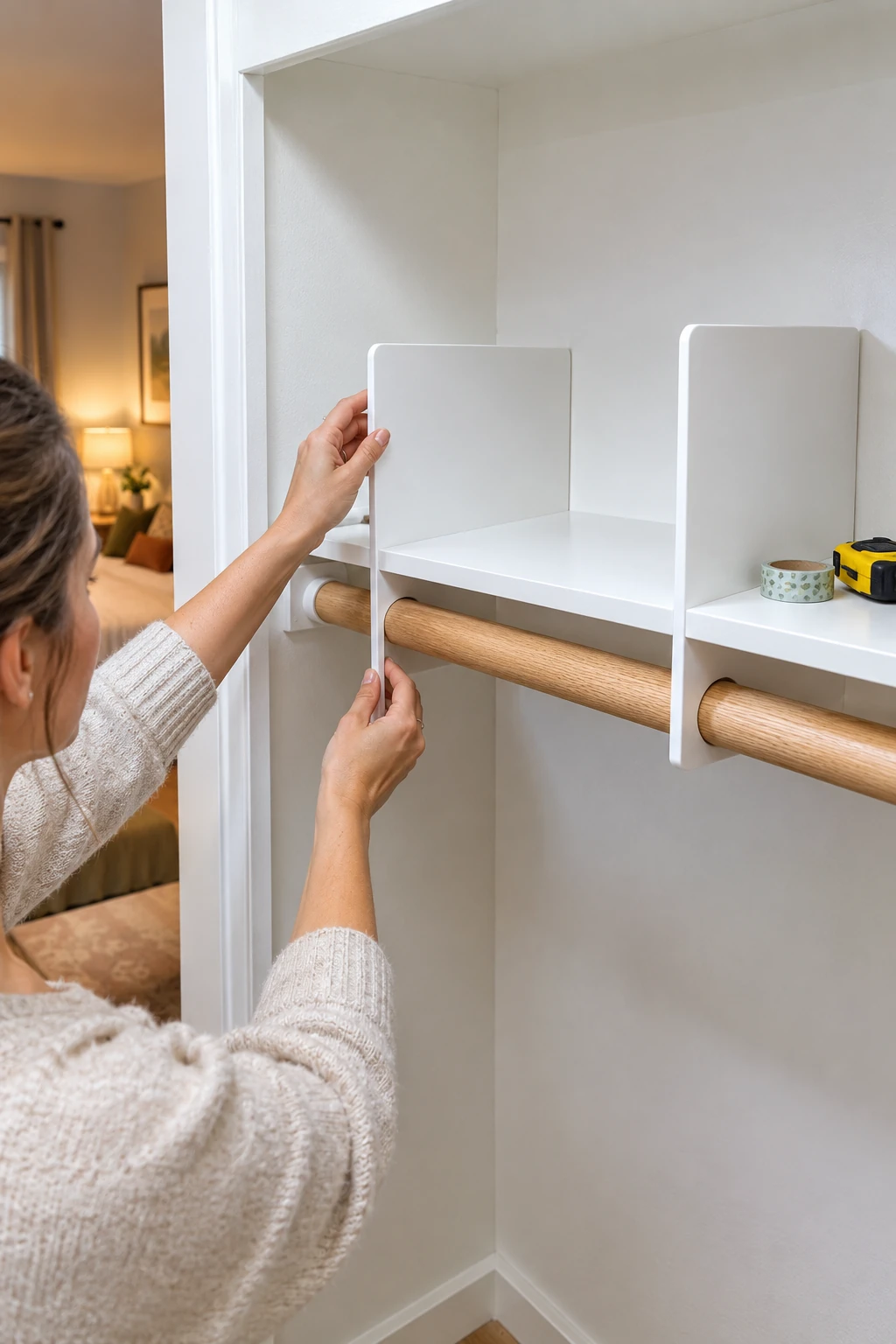
Nothing goes back in until the space has a map. Most nurse closets fail because work clothes and everything else compete for the same rod, so scrubs end up wherever there is room.
Three zones, left to right:
- Zone 1, ready sets. The most reachable stretch of rod, at eye and shoulder height
- Zone 2, backups and layers. The second rod, a shelf, or the far end of the main rod
- Zone 3, everything else. Off-day clothes, coats, anything not related to work
Measure roughly and mark the divisions with a shelf divider, a ribbon on the rod, or a strip of washi tape. Physical boundaries hold. Mental ones do not.
If your closet is a narrow reach-in or a shared bedroom situation, a small space setup can give you the same three zones vertically instead of horizontally.
5. Hang Three Complete Shift Sets in Grab-and-Go Order

A set means one top and one matching bottom on the same hanger, bottom folded over the bar with the top hanging in front of it. One grab, one full outfit, zero matching required at 5am.
Hang all three sets in Zone 1, facing the same direction, with about two inches of breathing room between them.
Order them the way you will wear them. Set One closest to the closet opening, Set Two behind it, Set Three at the back. You work through them left to right across your three shifts and never think about which one is next.
6. Store Your Backup Sets on the Second Rod or Shelf
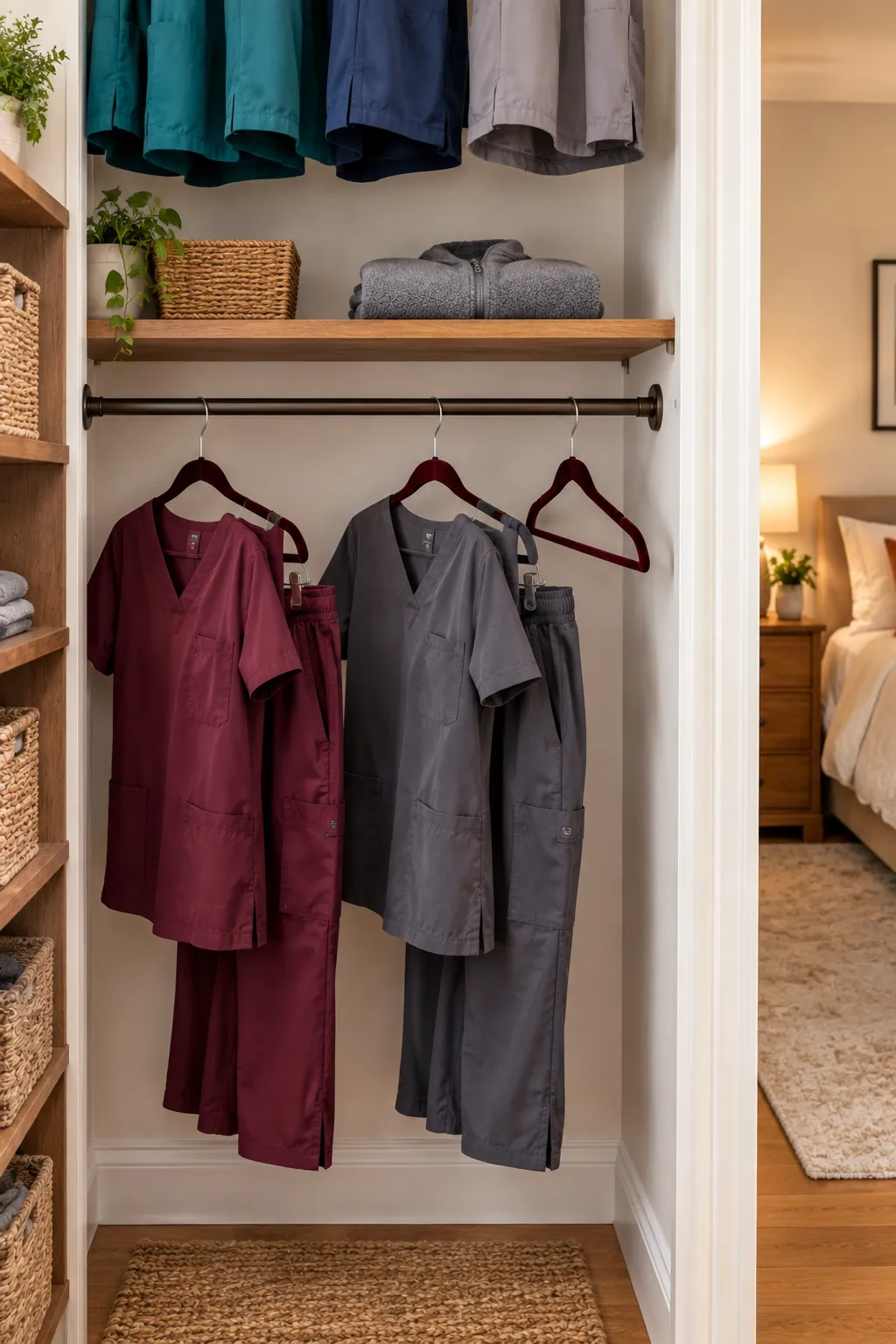
Backups live in Zone 2, paired on hangers the same way as your ready sets. Close enough to grab mid-crisis, far enough that they never get pulled into the daily rotation by accident.
Two complete sets is the right number here.
When a ready set goes to the laundry, a backup moves up into Zone 1 and takes its place. The system stays full without you thinking about it.
7. Give Your Layering Pieces Their Own Shelf

Long-sleeve tees, fleece jackets, and warm-up tops are the pieces you grab last and lose first. On a rod they take up prime hanging space. In a drawer they disappear.
A shelf above Zone 1 solves both problems. Fold them in stacks of three or four, sorted by type, not color.
Keep the stack you reach for most at eye level. In a cold unit that is your long sleeves. On a warm floor it is the lightweight jackets you only need for the walk in.
8. Set Up a Landing Bin for Shoes and Compression Socks
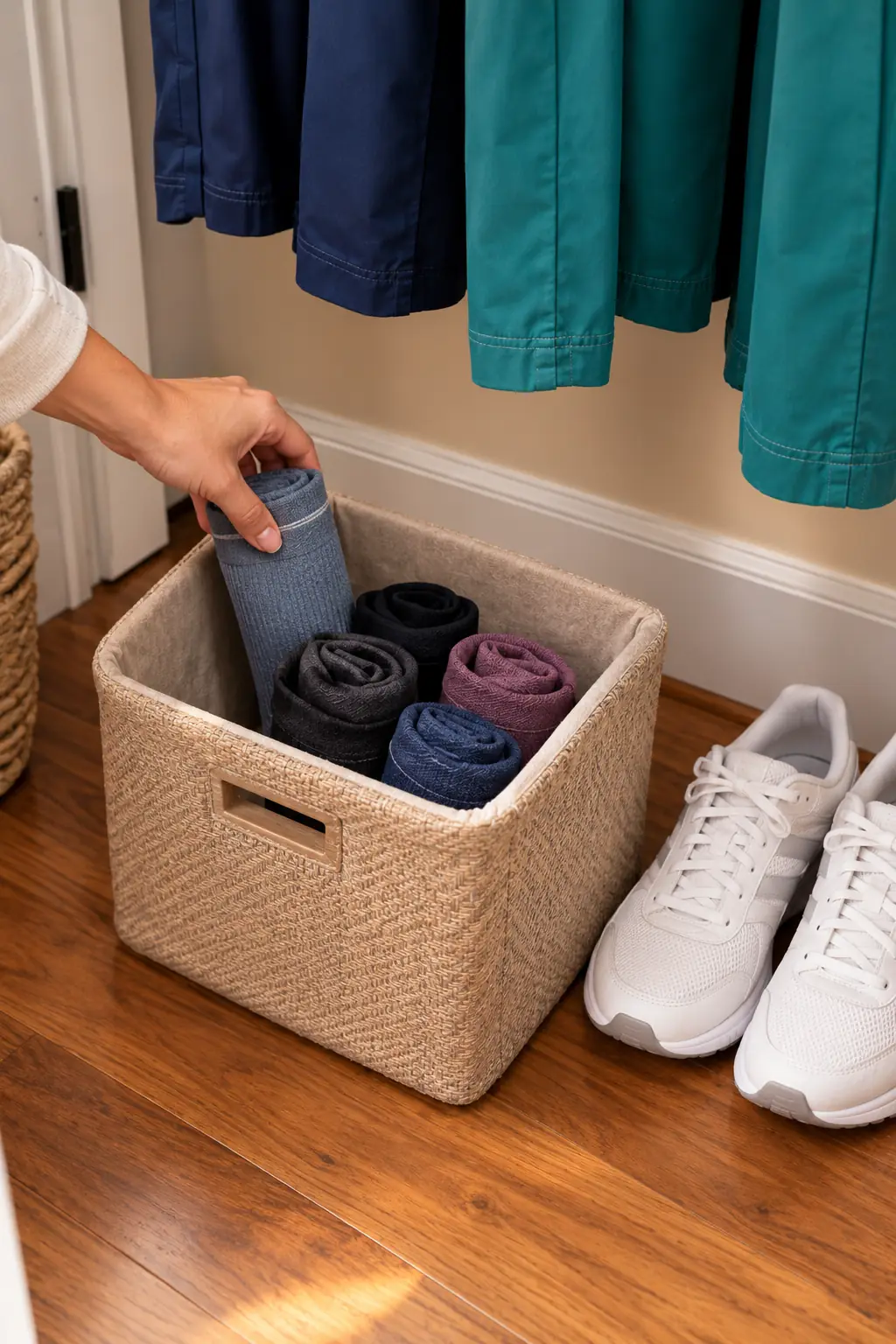
One bin, on the closet floor, directly under Zone 1. Everything that goes on your feet for a shift lives there and nowhere else.
Compression socks are the real reason this step exists. They get separated in the laundry, they migrate into sock drawers, and you spend four minutes hunting the mate at 5:30am. Rolled in pairs, in the bin, they stay together.
Your work shoes go in the bin only if they have already been wiped down. If shoes come off at your door as part of a drop zone routine, keep the bin for socks and a backup pair instead.
9. Keep Badge Reels, Penlights, and Pocket Gear in One Tray
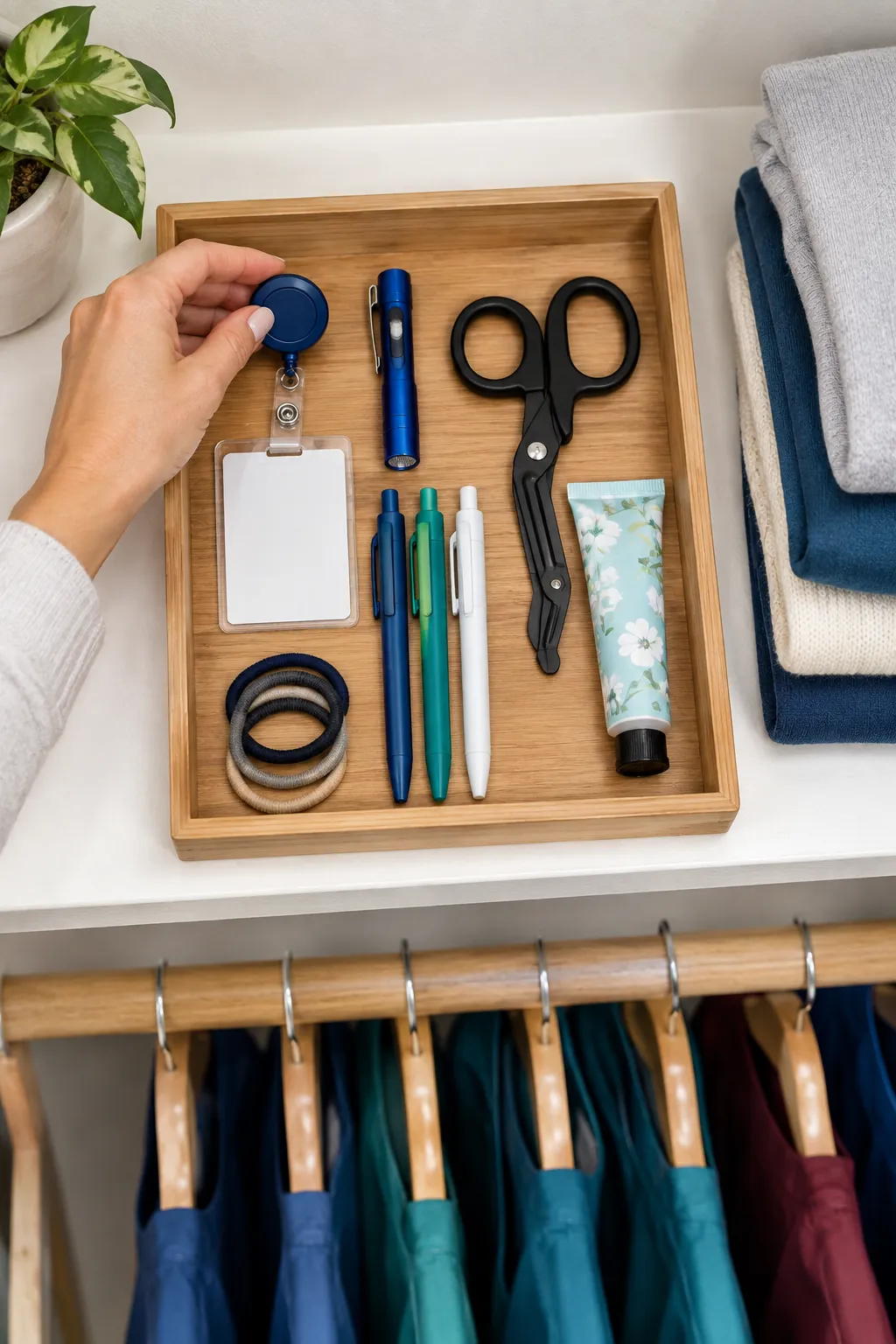
Small items are what actually make you late. A shallow tray on the layering shelf holds all of it in one place.
What goes in:
- Badge and retractable reel
- Penlight and trauma shears
- Pens that actually work
- Hair ties and bobby pins
- Lip balm and hand cream
Shallow matters. A deep bin turns into a junk drawer within two weeks and you are digging again. If everything sits in a single visible layer, you can see the gap the moment something is missing.
10. Add a Return Slot for Clean Scrubs Coming Out of the Laundry

Every closet system dies at the same point. Laundry day.
Clean scrubs come out of the dryer, the closet is mid-rotation, and the folded pile lands on a chair instead of a hanger. Two weeks later the chair is the closet.
Leave one empty hanger slot at the back of Zone 2 permanently. That is the return slot. Clean sets get paired on a hanger and go straight there, then rotate forward into Zone 1 as the ready sets get used.
Pairing happens at the dryer, not at the closet. Fold the bottom over the hanger bar, hang the top in front, walk it in as one piece. If your laundry setup has room for a small hanging rod near the dryer, the whole handoff takes about 30 seconds.
11. Reset Your Nurse’s Uniform Closet the Night Before Your First Shift
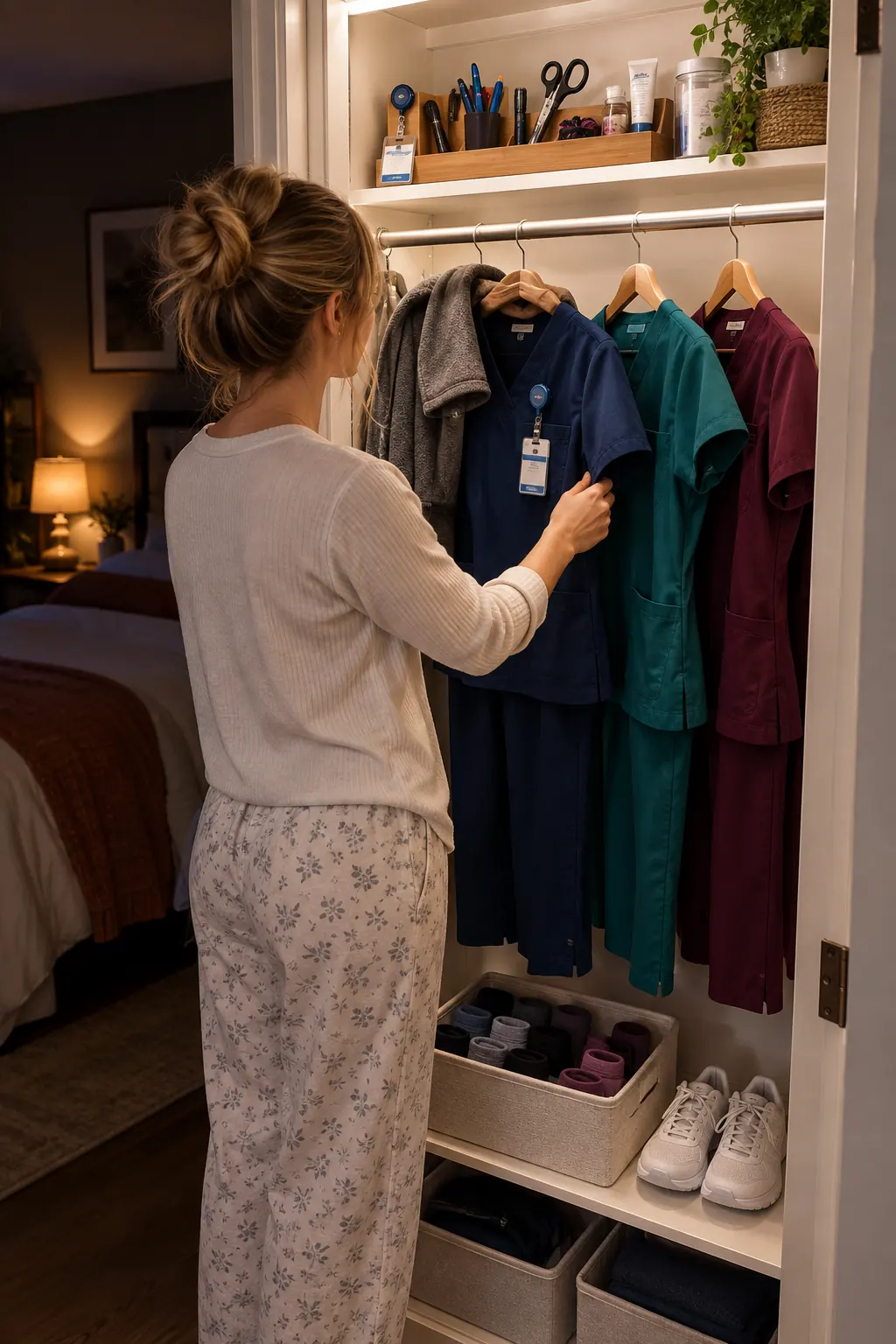
Five minutes, the night before shift one. This is the step that keeps everything else working.
Walk through four checks:
- Three complete sets hanging in Zone 1, in order
- Layering piece pulled and set on top of Set One if the unit runs cold
- Socks rolled and in the bin, shoes wiped
- Tray stocked, badge clipped and ready
Do this while you are still awake, not at the end of a wind-down routine when you are half asleep.
The payoff shows up most on night shifts, when you are dressing in a blacked-out bedroom and cannot see well enough to make choices. A closet you reset the night before works fine in near-darkness. One you did not, does not.
When the System Slips
Closet Questions, Sorted
How many scrub sets do I actually need for 3×12?
Five complete sets is the working floor. Three for your shifts, two as backups. Anything beyond seven starts taking space the system needs without adding real flexibility.
What if my closet is shared with a partner?
Claim one vertical section rather than a horizontal stripe. A hanging shelf organizer turns a narrow slice of rod into all three zones stacked, so your system stays intact without taking over their side.
Should I hang or fold my scrubs?
Hang your ready and backup sets so they stay paired and wrinkle-free. Fold layering pieces and anything knit. The rule is simple: if it needs a match, it hangs.
Does this work for rotating or non-3×12 schedules?
Yes. Change the number of ready sets to match your longest consecutive stretch. Four 10s means four sets in Zone 1. The zones and the return slot stay exactly the same.
Where do dirty scrubs go in this system?
Not in the closet. Dirty scrubs belong in a separate hamper away from clean clothes, ideally near where you change when you get home. Mixing them undoes the point of the whole setup.
How often should I redo the sort?
A full sort twice a year is plenty once the system is running. The weekly upkeep is the return slot and the night-before reset, which together take under ten minutes.
Your Closet in Three Sentences
Three ready sets hang at eye level, paired and in wear order. Two backups and one empty return slot sit behind them. Everything else lives outside Zone 1 and stays there.
That is the entire system. It survives a bad laundry week, a double, and a 4:50am alarm because the decisions were made on your day off instead of in the dark.
Your next rotation is where you will actually feel it. Not tomorrow, not in theory. The first morning you reach for Set One without looking.
Each of those three has a guide of its own. The wash method handles the way in. The come-home routine handles the way out. And if your four days off still disappear into recovery, reset day ideas are worth a read before your next stretch.
Pin this one so it is open next to you when you start pulling everything out.
