

You clock out at 7 a.m., drive home while the sun comes up, and climb into bed by 8. Then you lie there, wide awake. The birds are loud, the light is bright, and your body swears it is daytime, because it is.
If that is your life three nights a week, you are not broken and you are not doing it wrong. Your body is doing exactly what it was built to do. The trouble is that night shift sleep for nurses runs against millions of years of wiring, and nobody hands you a manual on day one.
This is that manual. By the end, you will have a full setup and a routine that let you fall asleep during the day and stay asleep, even with the whole world awake outside your window.
We will start with why your body pushes back, then fix your room, your timing, your light, your caffeine, and your meals, one piece at a time. None of it is hard on its own. Stacked together, it is the difference between dragging through every shift and actually feeling rested.
Be patient with the clock. Most nurses feel a real change within 2 to 4 weeks, and the setup itself takes one afternoon. Let’s get you sleeping.
- Why your body fights daytime sleep
- Blocking every trace of daylight
- Cooling and quieting the room
- Choosing a schedule for your rotation
- Using light and dark to reset your clock
- Protecting the drive home
- Building a wind-down routine
- Using caffeine as a tool
- Timing meals around sleep
- Approaching melatonin with care
- Guarding sleep from noise and people
- Resetting on your days off
- Spotting shift work sleep disorder
Understand Why Your Body Fights Daytime Sleep

Your body runs on an internal clock. It sits deep in your brain and takes its main cue from light. When sunlight hits your eyes, that clock sends one message to your whole body: stay awake.
That message shuts down melatonin, the hormone that makes you feel sleepy. So even after a hard shift, daylight keeps your sleep light and broken. You are exhausted, but your brain is still reading the room as daytime.
This is the root of nearly every night shift sleep struggle for nurses. It also points straight to the fix. Almost everything in this guide is about feeding your clock the opposite signal, so your body finally believes it is night.
Block Every Trace of Daylight From Your Room
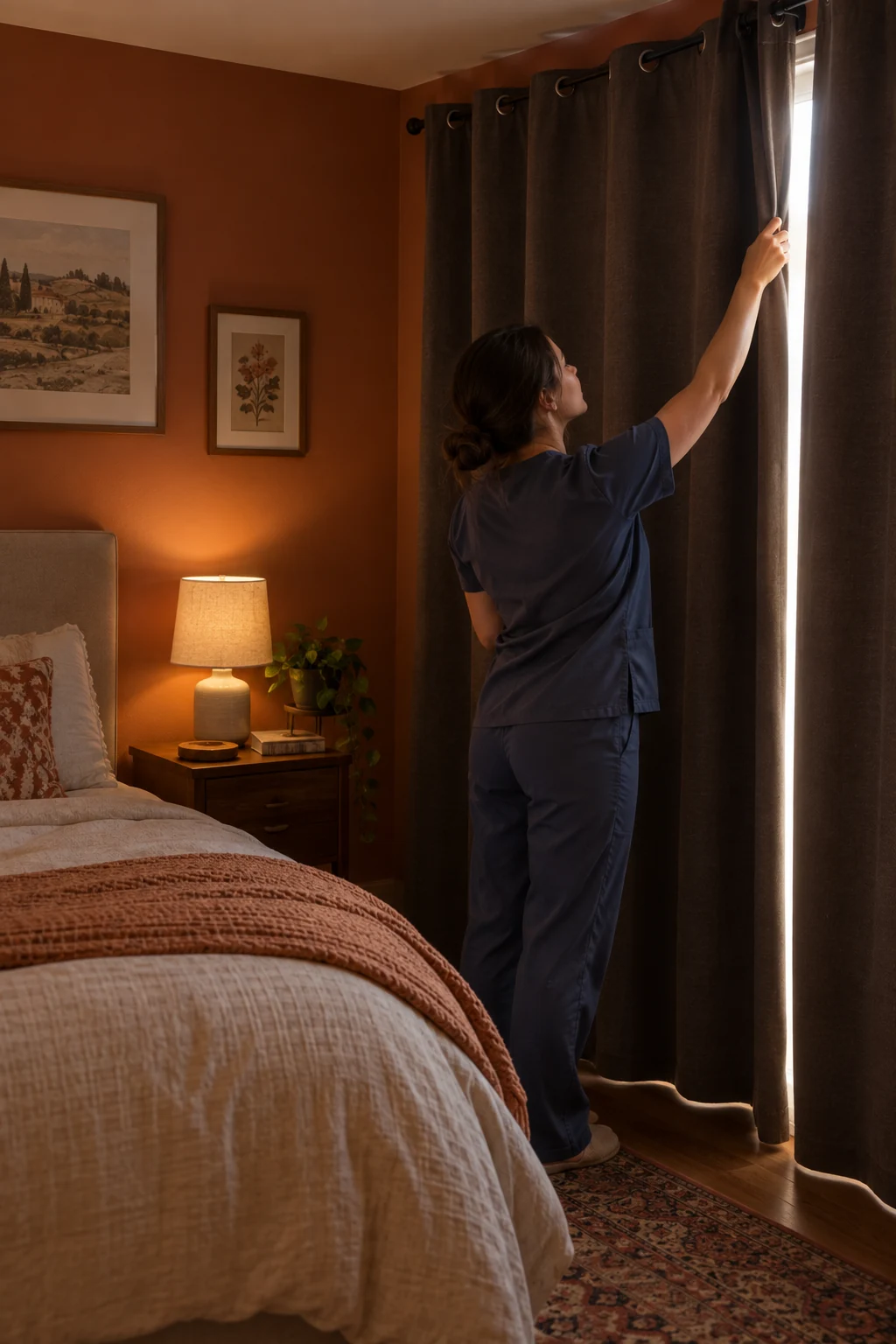
Light is the one signal your brain trusts most. A thin line of it slipping past your curtain is enough to pull you out of deep sleep without fully waking you.
Aim for a room so dark you cannot see your own hand in front of your face. Blackout curtains are the core buy, but most people forget that light leaks around the edges, not through the middle. Seal those gaps.
- The sides, where the curtain meets the wall
- The top, above the rod
- Any glowing dots from chargers, TVs, or power strips
No blackout curtains yet? A cheap blackout liner behind your normal ones works, and taping dark cardboard over the glass is a fine short-term fix. Keep a padded eye mask on the nightstand as backup for the light you cannot kill.
For a full walkthrough of turning a bright room into a sleep cave, see our guide to blackout bedroom ideas for nurses.
Cool and Quiet the Room for Deeper Rest

A warm room quietly wrecks day sleep. To fall asleep, your body drops its core temperature a degree or two, and a hot bedroom fights that the whole time.
Set the room to about 65°F (18°C). Anywhere from 60 to 67°F suits most people, and a fan helps you get there.
Silence is not your friend either, because one sharp sound can jolt you awake. Steady white noise masks the spikes from traffic, mail trucks, and mowers far better than quiet does. A white noise machine, a box fan, or a looping phone app all work.
If outside noise is your biggest battle, our renter-safe guide to soundproofing a bedroom covers fixes that never touch the walls.
Choose the Sleep Schedule That Fits Your Rotation

Two nurses can work the exact same shifts and still need completely different sleep plans. Your life outside the hospital decides which one is yours.
There are two patterns that actually hold up. The first is one long block right after work: get home, wind down, and sleep from around 8 a.m. until mid-afternoon. It keeps your body in night mode and works best across a run of shifts in a row.
The second is split sleep. You sleep a few hours after your shift, get up for the afternoon, then take a 1 to 2 hour nap before your next shift.
Lean toward split sleep if:
- You have kids to pick up from school
- You cannot stay asleep past 4 or 5 hours at a stretch
- You need daytime hours for errands or appointments
Pick one pattern and hold it across your whole run of nights. Trying to flip back to a normal schedule between every single shift is what leaves most nurses wrecked.
When your week mixes nights and days, our guide on how to flip your sleep schedule shows how to switch without losing a full day.
Use Light and Darkness to Reset Your Body Clock

The same sunshine that feels good on your face at 7 a.m. can quietly cancel the sleep you need at 9. Light is not background. It is the dial that sets your clock.
Use it on purpose. Early in your shift, lean into the bright hospital lights. They tell your brain to stay sharp and hold your clock in night mode.
In the last hour or two before you leave, dim what you can. A blast of morning light on the way out shoves your clock back toward daytime, which is the opposite of what you want.
Timing your main sleep around all this is its own skill. Our guide to how to sleep during the day after a night shift breaks down the exact hours to aim for.
Protect the Drive Home When You’re Wiped Out

The drive home is the most dangerous part of your whole night, and almost no one warns you about it. You are at your lowest point of alertness, steering a car straight into the sunrise.
Two things need to happen on that drive. You need to get home safe, and you need to protect the sleep waiting for you.
Put on dark, wraparound sunglasses the second you step outside. That morning light is a wake-up signal straight to your clock, and blocking it makes falling asleep at home far easier.
If your eyes are already heavy, do not tough it out. A 15 to 20 minute nap in the break room before you leave can be the difference between a safe drive and a scary one.
What you do the moment you walk in the door matters too. Our nurse come-home routine keeps the hospital from following you into bed.
Build a Wind-Down Routine Before You Sleep

You walk in the door still buzzing from the shift, and your body has no idea it is bedtime. A short routine, done the same way every day, is what tells it the workday is finally over.
Keep it simple and run it in the same order each time. Over a week or two, the routine itself becomes a signal that pulls you toward sleep.
A wind-down that works looks like this:
- Shower to rinse the shift off your skin and cool your body
- Change into clothes you only sleep in
- Dim the lights and set screens to warm night mode
- Do one calm thing: read a few pages, stretch, or breathe slow
Steer clear of anything that fires your brain back up. Answering one “quick” work email or scrolling the news can undo the whole routine and leave you staring at the ceiling.
For a full step-by-step version you can copy, see our guide on building a wind-down routine after a night shift.
Use Caffeine as a Tool, Not a Lifeline

Half the caffeine in your 3 a.m. coffee is still in your body six hours later. That is the part you do not feel, and it is the part that keeps you wide awake once you finally get home.
Caffeine has a half-life of about 5 to 6 hours, so the fix is timing, not quitting. Front-load it. Have your coffee or energy drink in the first half of your shift, then cut it off by the halfway mark.
After your cutoff, switch to water. Those early cups will still carry you through the hard pre-dawn hours, without stealing the sleep waiting for you at home.
Time Your Meals Around Your Sleep

Eat a greasy burger at 3 a.m. and your gut will keep you up long after you get home. On nights, when you eat matters almost as much as what you eat.
Have your main meal before your shift, the way you would sit down to dinner. Through the night, keep food light so your body is not stuck digesting when you need energy most.
In the small hours, steer clear of:
- Heavy, greasy, or fried food
- Big sugary snacks that spike, then crash you
- A full meal right before you sleep
If hunger hits before day sleep, a light protein snack settles you without weighing you down. Skip alcohol as a nightcap. It knocks you out fast, then chops your sleep into pieces a few hours later.
Approach Melatonin and Sleep Aids Carefully

Melatonin is not a knockout pill, even though the aisle it sits in makes it look like one. It is the same hormone your body already makes to signal night, so a small dose before day sleep can nudge your clock in the right direction.
More is not better here. Large doses tend to leave you groggy without deepening your sleep at all, and melatonin can clash with other medicines and health conditions.
Guard Your Sleep From the People and Pings Around You

You finally drift off, and then the doorbell rings. A minute later, a text. The world assumes daytime means you are available, so you have to tell it plainly that you are not.
Set these boundaries before you sleep:
- Put your phone on Do Not Disturb, with a favorites bypass for real emergencies
- Hang a clear “Day Sleeper” sign on your door and doorbell
- Tell family and roommates your exact sleep hours
- Silence notifications for anything that can wait
A printed sign is nice, but a sticky note that reads “Sleeping, please do not knock” does the job too. What matters is that people see it before they reach for the bell.
Most of your defenses live on one surface by the bed. Our nightstand setup ideas for night shift nurses show how to keep them all within reach.
Reset on Your Days Off Without Undoing Your Progress

Your days off are a trap in disguise. Flip all the way to a daytime schedule for two days, then flip back for your next shift, and you spend half your week jet-lagged in your own home.
The trick is to shift part way, not all the way. Keep one steady sleep anchor of about 4 to 5 hours that overlaps your workday sleep, then add the rest of your rest wherever it fits your life.
After your last shift in a run, sleep a shorter block, get up in the early afternoon, and enjoy your evening. Move your bedtime a little earlier each night, but never so far that your body forgets nights entirely.
Days off carry their own load of errands, cleaning, and actual rest. Our guides on reset day ideas for nurses, how to split your days off, and keeping a clean house on three 12s help you fit it all in without robbing your sleep.
Recognize When It’s Shift Work Sleep Disorder

Some tiredness on nights is normal. But when good habits are all in place and sleep still will not come, or you cannot stay awake when you need to, that is a sign to take seriously.
Shift work sleep disorder is a real, treatable condition, not a personal failing. It is worth a talk with your doctor when the signs below stick around for more than a few weeks.
Real help is out there, from schedule tweaks to treatments a sleep specialist can walk you through. Reaching out is a strong move, not a weak one.
Night Shift Sleep Troubleshooting
Even with the whole system in place, some nights fight back. Find your problem on the left and try the fix on the right.
Night Shift Sleep Questions Nurses Ask
How long until night shift sleep starts to feel normal?
Give it 2 to 4 weeks of doing the same things every day. Your body clock shifts slowly, so the first week is usually the roughest. Consistency is what speeds it up.
Should I sleep right after my shift or split it up?
Sleep one long block after work if you can stay down for it. Split your sleep if you have kids, errands, or you keep waking after a few hours. Both work, so pick the one that fits your real life.
How many hours of sleep do I really need on nights?
Aim for the same 7 to 9 hours you would need on days, even if it comes in two pieces. Broken daytime sleep is lighter, so you may need to protect a little extra time to feel rested.
Will I ever fully adjust, or always feel tired?
Most nurses adjust well enough to feel steady and function at their best. A few never love nights, and that is okay. If solid habits still leave you wrecked, it is worth ruling out shift work sleep disorder with your doctor.
What if I only work one or two night shifts a week?
This is actually harder, because your body never fully commits to nights. Keep a partial anchor near your night sleep on those days instead of flipping all the way. Our guide on flipping your sleep schedule covers this exact case.
- Remember your body clock runs on light
- Black out every bit of daylight
- Keep the room near 65°F with steady white noise
- Pick one sleep schedule and hold it all week
- Bright light early in your shift, dim it late
- Sunglasses on for the drive home
- Run the same wind-down every day
- Cut caffeine by your shift’s midpoint
- Big meal before work, light food overnight
- Ask a pharmacist before trying melatonin
- Do Not Disturb, plus a sign on the door
- Keep a partial sleep anchor on days off
You now have the full picture, from why your body pushes back to the exact fixes that work with it instead of against it.
Do not try to nail all of it tonight. Pick one thing, your dark room or your caffeine cutoff, and start there this week.
Better night shift sleep for nurses is not about willpower. It is a handful of small habits, stacked and repeated until they feel like second nature.
Pin this guide to your nursing board so it is waiting the next time you crawl into bed at sunrise. Your steady hands deserve a steady life.
